№ 114 | Platform Thinking Journey Cards, The Dictionary of Radical Alternatives, Learning Theory Map, “Let Them Have Your Way” Zine, a Framework Mashup!, “There is No System 2”, Go for Goals, and Gutenberg Revisited


Welcome to another curious roundup of ‘playful things to think with’ and think about!
Platform Thinking Journey Cards
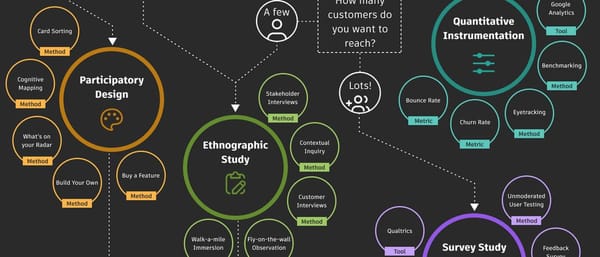
Here’s a shout out to my friend Werner Puchert, who just dropped another one of his extensive card deck video reviews. This time, he’s looking at the Platform Thinking Journey Cards—one of several tools found on the Platform Thinking site, which explores “how legacy companies can lead the platform revolution without burning everything.” I love his reminder throughout that these are not an ideation tool but “a strategic sense-making instrument…” with a goal to “help you ask better questions.” I also like that the cards seem to play off each other, almost like a methodology that’s been deconstructed into a playable card deck.

.
Before I share my next find, some priming and misdirection… 😉
I’m kind of in love with this quote shared by my friend Cat Hase:
If you can overthink the worst, why can't you overthink the best.
Just sit with that for a second…
.
On that note…
The Dictionary of Radical Alternatives
Check out The Dictionary of Radical Alternatives.
At first glance, I was thinking about alternative futures. This is not that. Or, if anything, it’s a precursor to imagining radical alternative futures.
As the name makes clear (ahem, in retrospect), The Dictionary of Radical Alternatives is a collection of terms—from around the world—for thinking beyond a “a model of life that privileges accumulation over care, extraction over reciprocity, and uniformity over diversity.” Instead of more ideas that have reached their limits, we have words like Susu, Swaraj, and Decentralization.
Also, this could make a really nice card deck. Being able to hold various ideas in contrast with each other, or arrange them in ways so as to discover patterns… This feels consistent with the aim of creating “a space in which different worldviews, practices, and common terms could come into dialogue.”
Oh, and if you’re reading this in time, there’s a platform launch event for The Dictionary of Radical Alternatives this Tuesday (March 24th).

Learning Theory Map
My friend Raghav Agrawal recently shared this with me, exclaiming: “Stephen check this out, you're going to love it.” Yeah… he was right.
I maintain a visual notebook of all kinds of learning theories, including ideas about learning we can borrow from games of all kinds. I’m starting to turn the corner where I’m trying to make sense of all these different ideas about learning, the research behind each, and so on. This Learning Theory Map explores established learning theories, and attempts to “map and link key scientific disciplines, theorists, concepts and paradigms.”
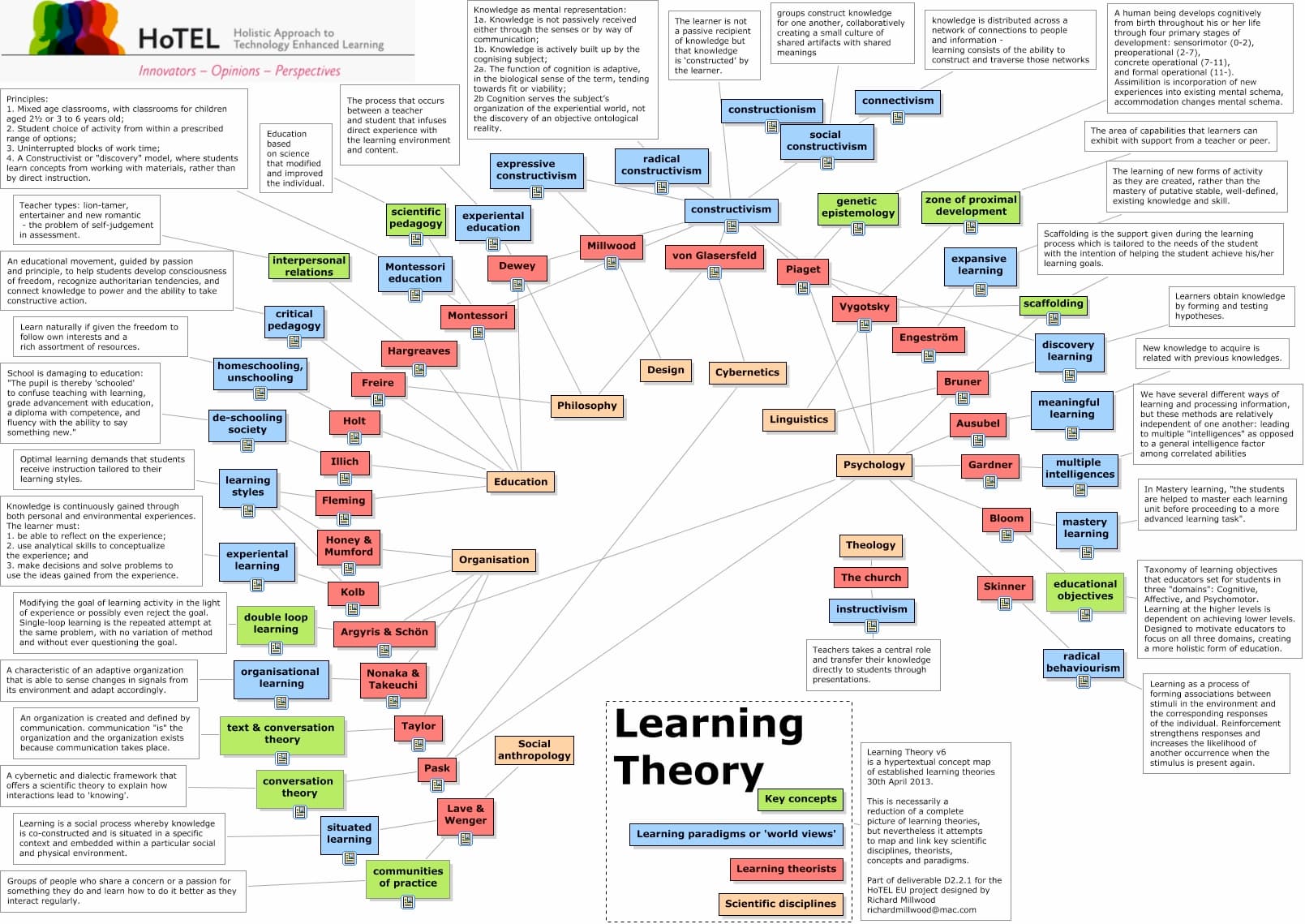
Yeah, this is going on my wall, right next to The Map of Boardgames.
“Let them have your way” Zine
What?! There are people who aren’t into zines? Apparently, Ryan Rumsey (founder of the Chief Design Officer School, among other things) printed this zine to hand out at a conference, and… as he shares in this short LinkedIn post “I quickly realized that the other conference goers were not zine kinda people.”
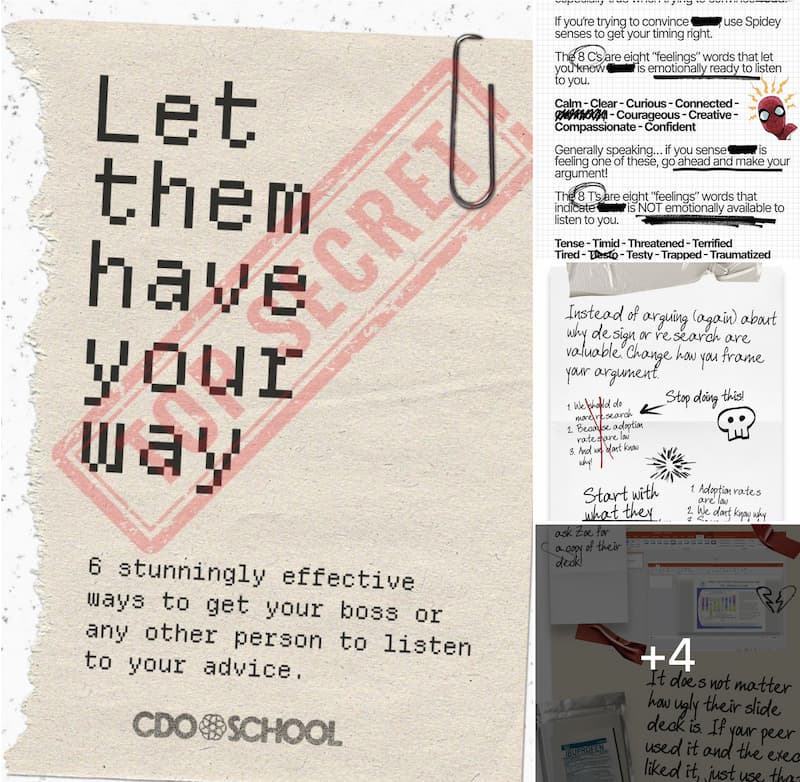
Fortunately, we are zine people, and we’re quite delighted that Ryan has chosen to share this zine with us. As with many zines of this nature, it’s a highly concentrated bit of wisdom. The topic? “Six stunningly effective ways to get your boss or any other person to listen to your advice.”
Now, how do I track down one of the printed copies he mentions… 😉
Product adoption & switching (a framework mashup!)
Two frameworks I love—in a mashup? 🤪
That’s what Alexander Osterwalder, Founder & CEO Strategyzer, proposes in this short LinkedIn post on product adoption / switching.
In one corner, we have Strategyzer’s Value Proposition Canvas, “a tool to understand what customers really want.” Gains. Pains. Vitamins. Painkillers. That whole thing.
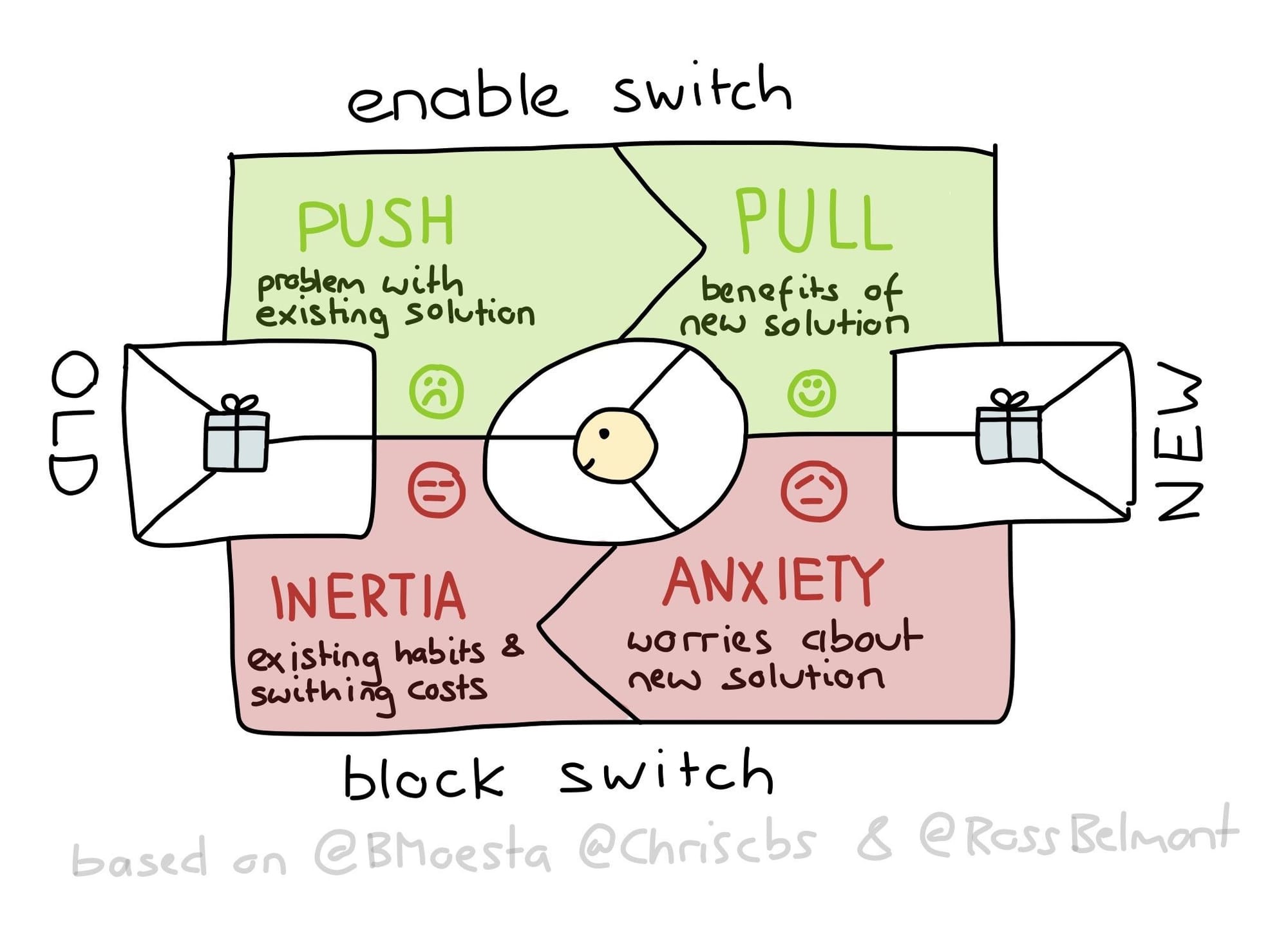
In the other corner, we have the Four Forces framework. For the uninitiated, this is a quite useful tool to understand and shape behaviors when asking people to change from one way of doing things to another. You have Push and Pull forces that motivate change, while Anxiety and Inertia forces hinder that change.
Now, mash ‘em up and you get something that, well… makes a ton of sense. Overlay a current state and future state Value Proposition half of the VPC on either end of the old way / new way of doing things, place the Customer Segment in the middle (after all, people are people), and… it’s peanut butter and chocolate!
“There is no System 2”
A few weeks ago, I shared a post about AI functioning as a kind of System 3, building on the System 1 and System 2 modes of thinking popularized by Daniel Kahneman. Now, here’s a post challenging whether there even is a system 2… Wait, what?! 🤨
The central idea is that System 2 does not exist; it is System 1 all the way down.
This might sound like heresy, given the popularity of System 1 / System 2 thinking, but… The post is well-researched and a good reminder that even “sacred cows” like S1/S2 thinking are useful models (and all models are wrong). I will add, selfishly, that this post resonated with me; pattern matching—all the way down—was how I explained thinking in my book Figure It Out.

Go for Goals – A United Nations Card Game
While searching for information about the 2030 SDGs Game (mentioned in issue № 113), I also came across this United Nations card game Go for Goals. It’s described as “the first card game that tangibly demonstrates how positively contributing to the UN SDGs creates real impact for the good of humanity.” The game itself looks straightforward, combining hand management with the addition of unpredictable Event cards.

Gutenberg, distribution, and hub systems.
Here’s a fascinating dig into the overlooked details of history. I grew up thinking only about how Gutenberg and the printing press revolutionized the world. And while that’s sort of true, there is (as with most new inventions) more to the story. I’ll tease you with the opening sentences from this insightful, short video:

You’re Gutenberg. You have figured out how to produce 300 copies of a book for the cost of one copy of a book. You do so. You print your Bible. You have 300 Bibles. You sell seven of them to the seven people in your small landlocked German town who are legally allowed to read the Bible in a period in which only priests were allowed to read the Bible. Congratulations Mr. Gutenberg. You have 293 Bibles, you can’t sell them, and you go bankrupt. There has to be a distribution mechanism for books to find their market because there are certainly 300 people in Europe that want this, but there are not three hundred people in one location where it’s being produced.
In this case, the ability to mass produce books also needed a “hub system” to reach a broader audience… Thank you, Prof. Ada Palmer for sharing this bit of history with us!