№ 116 | Mapping the Sources of Power, The Atlas of New Futures, Factitious, Mutual Aid Self Care Zine, Lecture-Zines by Darren Raven, Wild Cards Deck, and the Weight of Worry
Share
№ 116 | Mapping the Sources of Power, The Atlas of New Futures, Factitious, Mutual Aid Self Care Zine, Lecture-Zines by Darren Raven, Wild Cards Deck, and the Weight of Worry

Hello, and welcome to another edition of Thinking Things, your mostly-regular dose of ‘Playful Things to Think With’ (and think about).

Mapping the Sources of Power

By way of a LinkedIn post from Scott Wolfson comes this map depicting “how experts actually make decisions.”
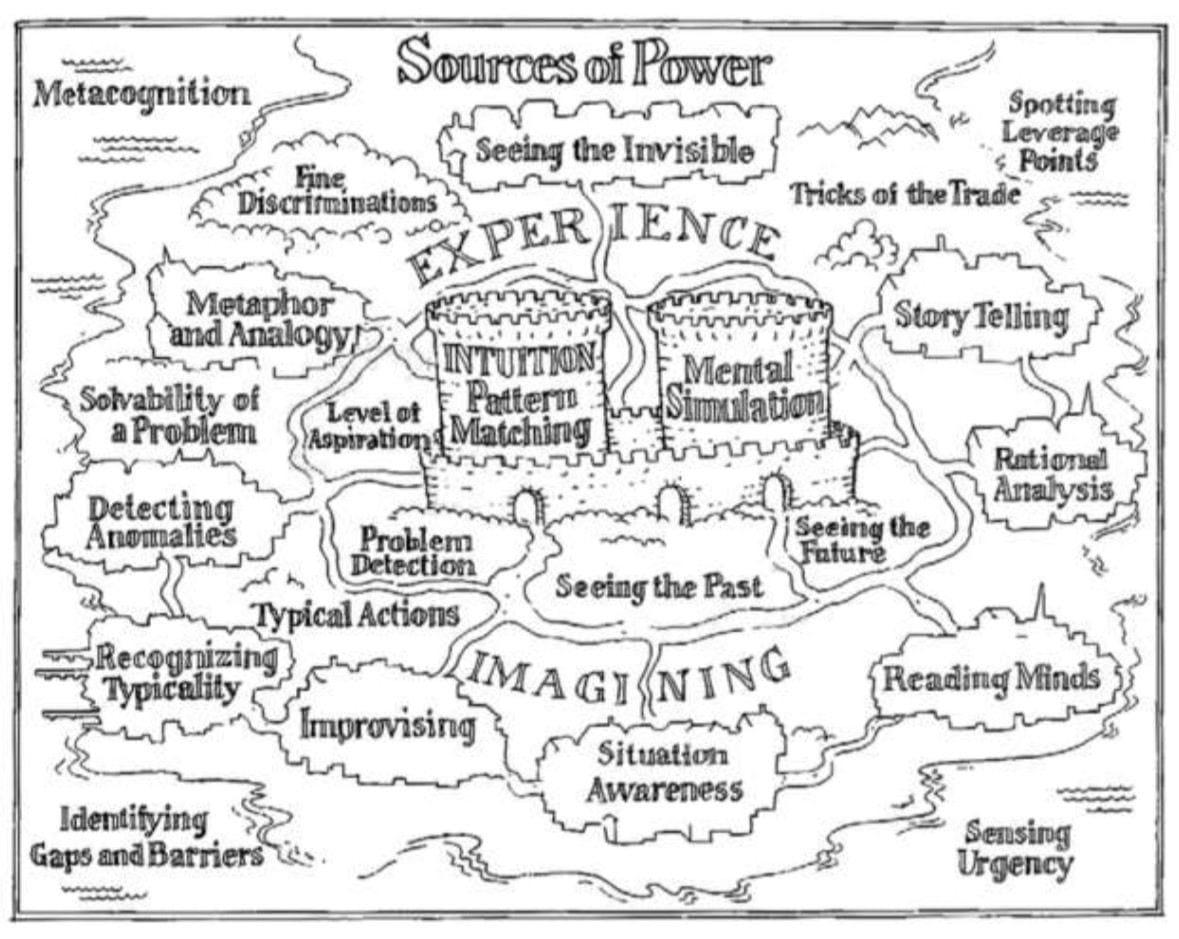
A hand-drawn concept map titled 'Sources of Power' showing interconnected cognitive skills and decision-making processes. The map is structured like a fortress or castle with two main towers labeled 'INTUITION' (containing 'Pattern Matching' and 'Level of Aspiration') and 'Mental Simulation' at the center under 'EXPERIENCE.' Surrounding these central concepts are various skills arranged in cloud-like bubbles including: Metacognition, Seeing the Invisible, Fine Discriminations, Metaphor and Analogy, Solvability of a Problem, Detecting Anomalies, Problem Detection, Typical Actions, Recognizing Typicality, Improvising, Identifying Gaps and Barriers, Situation Awareness, Seeing the Past, Seeing the Future, Rational Analysis, Reading Minds, Sensing Urgency, Story Telling, Tricks of the Trade, and Spotting Leverage Points. The word 'IMAGINING' appears at the bottom of the fortress structure.

It’s a hand drawn conceptual landscape from the book Sources of Power, identifying various “cognitive superpowers.” According to Gary Klein, author of the book, his research showed these kinds of skills consistently outperform careful analysis: Intuition. Pattern matching. Mental simulation. Storytelling. Reading minds. Detecting anomalies. Improvising. Metacognition. Seeing the future.

Scott comments on the relevance of these skills (identified in 1998) to today’s AI conversations

Every. Single. Territory. On this map is something AI cannot do.

Not “cannot do yet.”

Cannot do. Full stop.

What stopped me was the artifact itself (FWIW, I’m gathering a small collection of these allegorical maps). But, I was also curious about the source material, which… eventually led me to this 2017 article in Psychology TodayMapping the Sources of Power” written by the author, revisiting his map after nearly two decades.
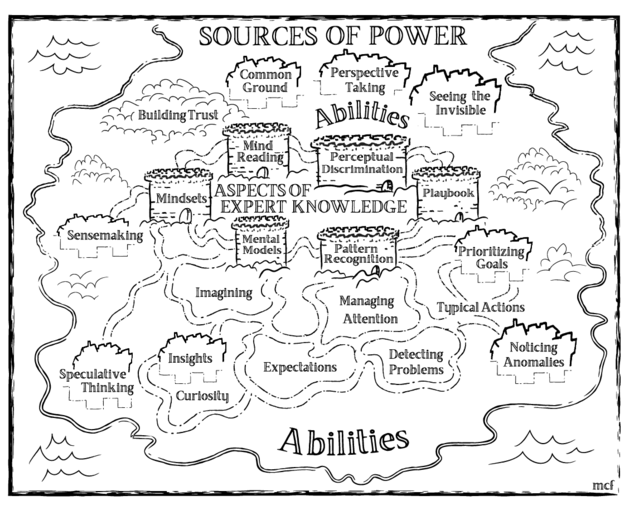
A hand-drawn concept map titled 'SOURCES OF POWER' showing the relationship between expert knowledge and abilities. At the center is a castle-like structure labeled 'SOURCES OF EXPERT KNOWLEDGE' with towers containing: Mental Models, Mindsets, Mental Simulation, Perceptual Discrimination, and Pattern Recognition. Surrounding this central fortress are cloud-shaped bubbles representing various abilities including: Common Ground, Building Trust, Perspective Taking, Seeing the Invisible, Sensemaking, Imagining, Insights, Speculative Thinking, Curiosity, Managing Attention, Expectations, Detecting Problems, Noticing Anomalies, Typical Actions, and Prioritizing Goals. The word 'Abilities' appears both at the top (near the fortress) and bottom of the map. The entire diagram is framed by wavy lines suggesting water.

I’ve commented before about how I love to witness people’s thoughts changing over time. What’s beautiful about the article is not only the updated version of this map, but his thoughts as to what has shifted for him. After noting the updates he’d make are relatively minor, he does add this:

In reviewing the 1998 map I found myself making a distinction between the types of knowledge people have and the abilities that their experience enable. The 1998 map doesn’t make this distinction and I think it might be important.

Speaking of maps…

The Atlas of New Futures

Futures? Archetypes? You got my attention!

The latest edition of the AXA Foresight Report describes 5 ‘New Futures Archetypes’ (NFAs)—with archetypes here focused on territories (think places you might visit); each of the archetypes looks out 15 years at “possible worlds shaped by climate change, technological evolution, demographic shifts and geopolitical dynamics.” The five identified archetypes are described as

worlds in a box that represent distinct takes on the future, developed in collaboration with partner institutions and open for others to use and build upon
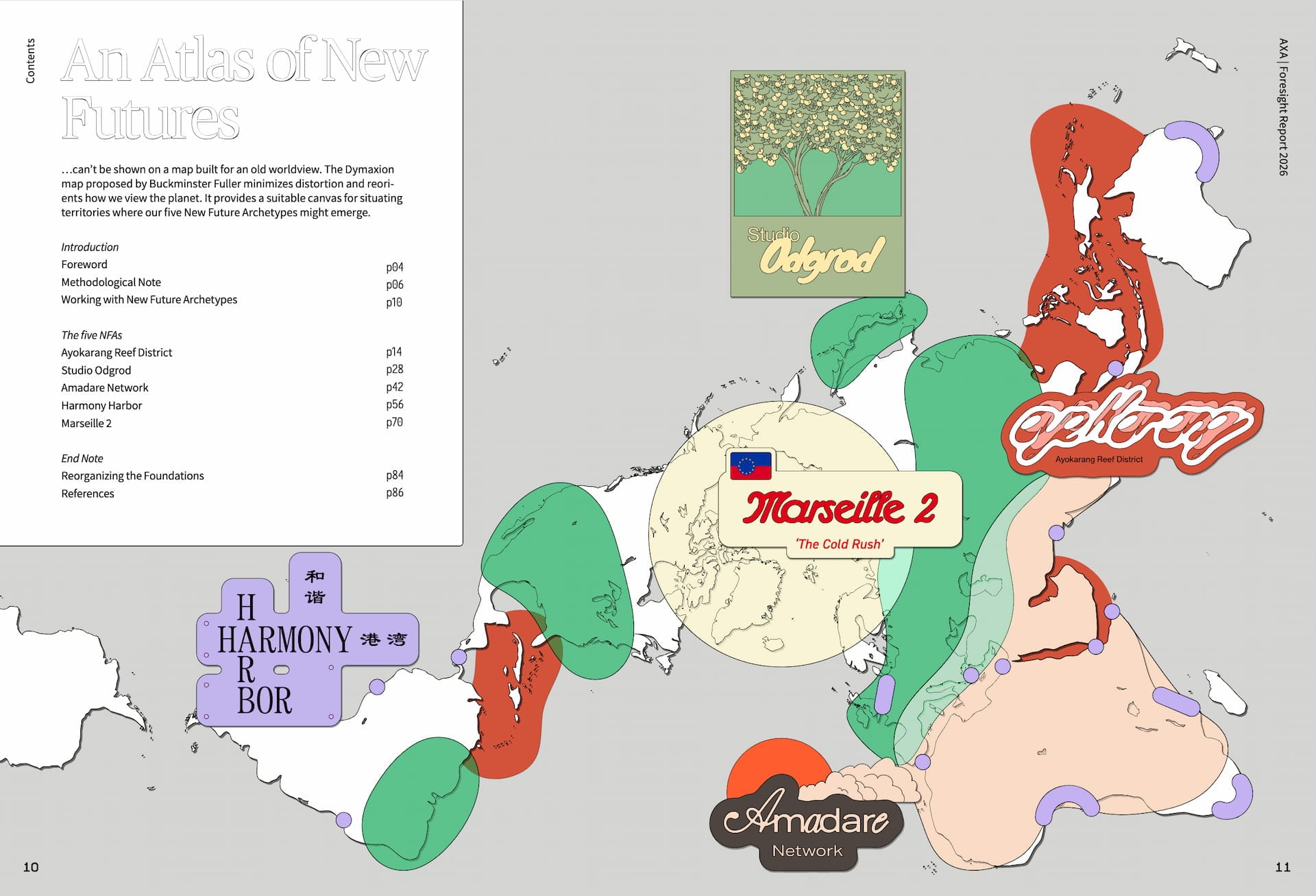
Map of an imagined geography, with the label "An Atlas of New Futures". On this map, 5 regions are labeled (with a custom typographic treatment) as follows: Ayokarang Reef District, Studio Odgrod, Amadare Network, Harmony Harbor, and Marseille 2. This map also serves as the table of contents for the rest of the report.


One detail I especially enjoyed—after sharing the five archetypes and the drivers behind each—is the invitation to explore and create your own archetype, and the structured framework (of sorts!) to do so:
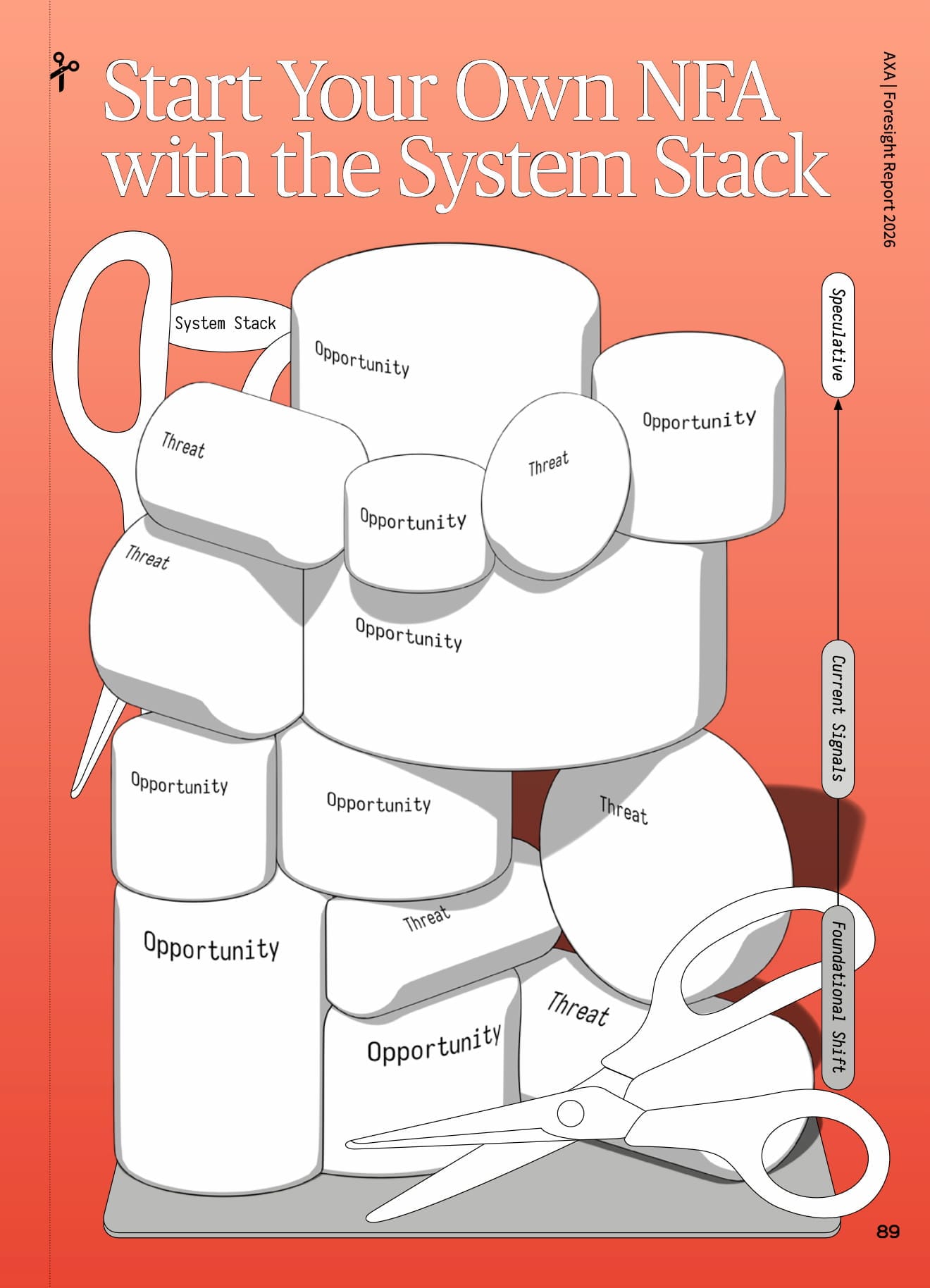
A "framework" of sorts with the headline "Start Your Own NFA with the System Stack" The frameworks consists of an isometric illustration of stacked cylinders of various sizes and lengths, each empty(ready to be filled in) with either "Threat" or "Opportunity" as indicated by the label on each. The stack of cylinder shapes have a vertical axis or scale, which reads (from bottom to top) Foundational Shift, Current Signals, and Speculative.

Speaking of futures…

Collective Dreaming Deck

This is a find I’ve been sitting on for a bit, waiting for the right moment (I think it pairs nicely with The Atlas of New Futures). The Collective Dreaming Deck from UN Global Pulse is “an interactive card-based game designed to spark collective imagination and support speculative scenario building.” It’s a free download. And, I love the specificity of the prompts, ranging from ‘gene hacking becoming commonplace’ to ‘systems for climate reparations’ to ‘moveable cities’. 🤪
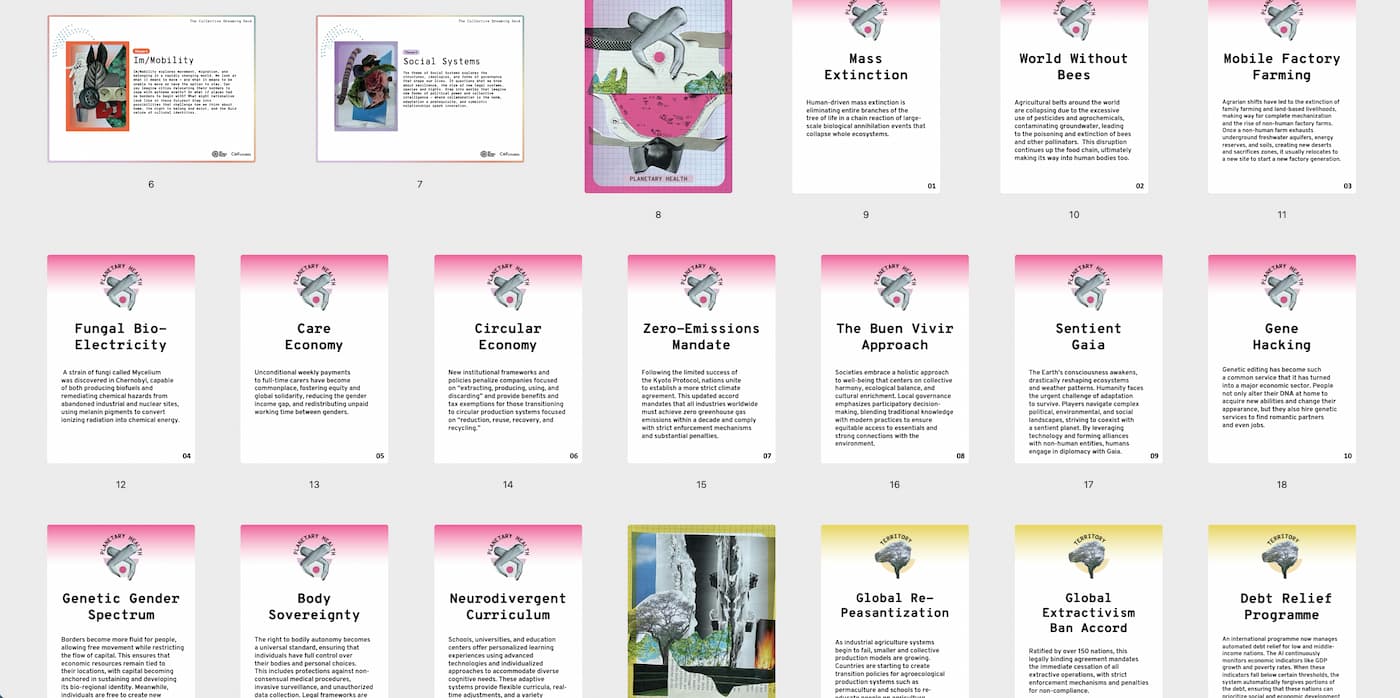
Screenshot of assorted cards. Card title can be read, and include things like "Mass Extinction", "World Without Bees", "Mobile Factory Farming" "Fungal Bio-Electricity" and "Care Economy".

Instructions are straightforward: Draw 3 cards at random; construct a story or scenario inspired by these cards.

Factitious

Ooh, a game to test (y)our media literacy. I think this was created for a college course with a goal “to teach people about fake and misleading news and not trusting everything you see on the internet.” Fortunately, the creators have graciously shared this with the rest of us! I was a “sharp reader” with 17 of 19 articles correctly identified (I’ll blame those two on the pressure of the timed response). Try it. See how you do!
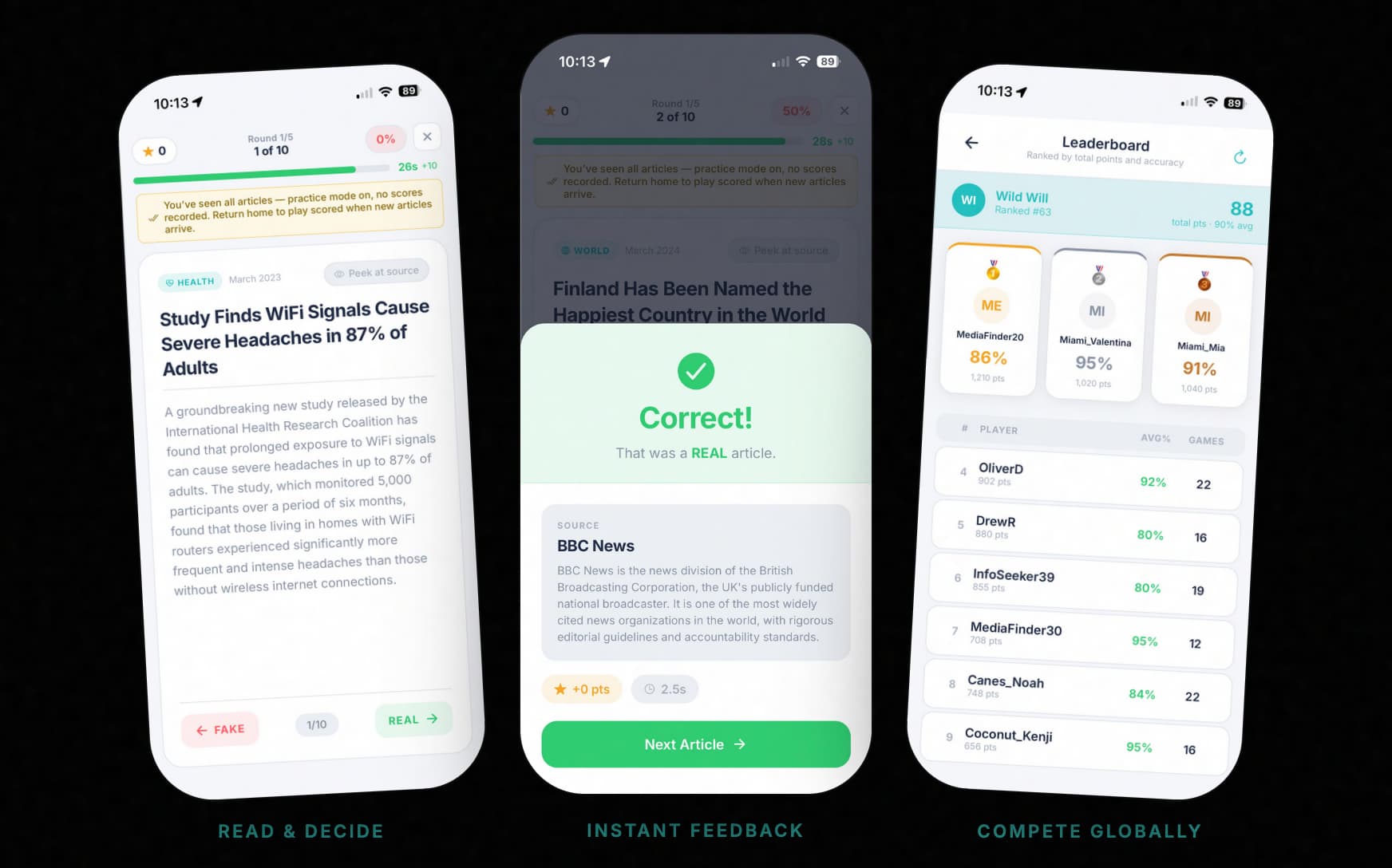
3 screenshots of the mobile game Factitious. Screen 1 shows an article with "Fake" and "Real" buttons options at the bottom. Screen 2 shows a success state, when an article has been correctly identified as Real (in this case) or fake. Screen 3 shows a leaderboard and associated stats.

Mutual Aid Self Care zine

More analog goodness from Alastair Somerville. This time, it’s the Mutual Aid Self Care zine, a simple zine you co-create (by answering reflection questions) to help you when you’re feeling anxious or overwhelmed.

Clever little detail: It’s kind of two zines in one, depending on how you open it: One direction focuses on ‘How I help me’, to remind yourself of things you can do; the other direction focuses on ‘How you can help me’, things you can choose to ask of or share with others.
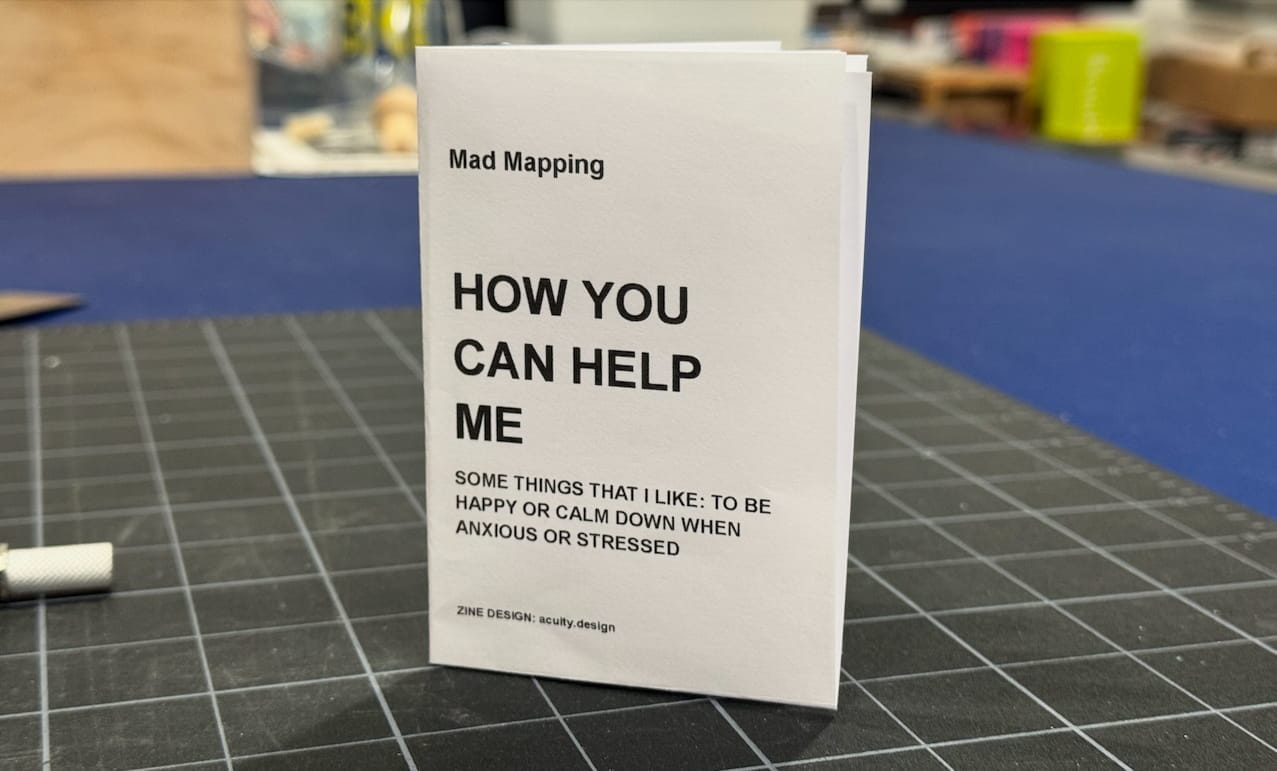
Photo of a hand-assembled black and white zine on a crafts table. Zine is titled "How you can help me."

For a more comprehensive version of this same material, check out the referenced zine Mapping Our Madness: A workbook for navigating crisis, extreme states, or just foul moods.

Speaking of zines…

Lecture-Zines by Darren Raven

“Amaze amaze amaze!” (Reference to Project Hail Mary, which I just got done re-reading and watching; I recommend both the book and the movie).

But as I was saying… WOW, is this next find going to blow your mind.

Just go ahead and check out these Lecture-Zines by Darren Raven.

First, there’s the sheer magnitude of this project. 365 zines! 😲 But, each zine is like a concentrated dose of related concepts, frameworks, mental models, and other ideas—things to think with and think about. Plus, citations included in every zine.

I made the mistake of jumping in somewhere in the middle (more on that in a moment), and missed out on this quite useful context from the first zine:
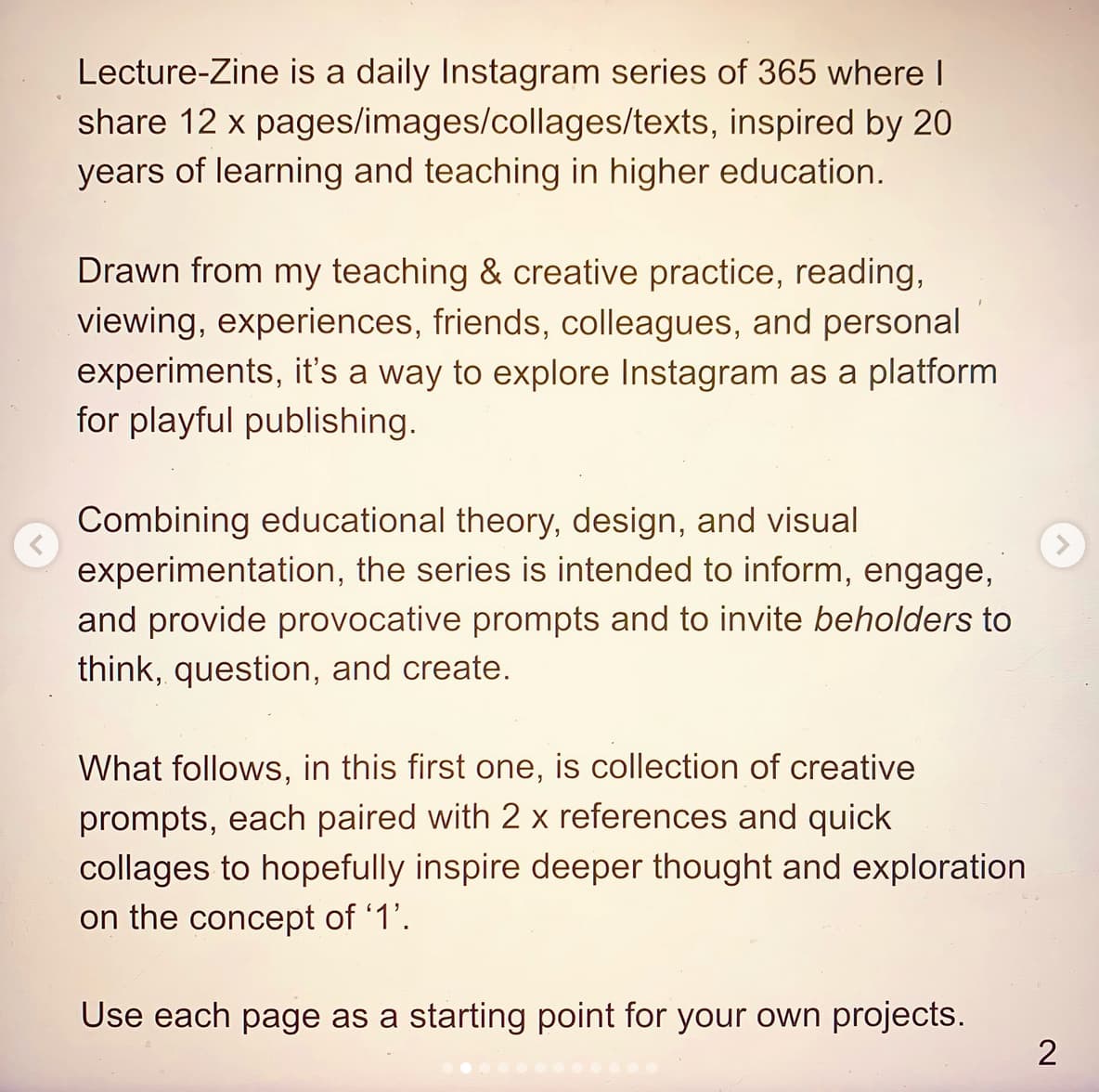
Lecture-Zine is a daily Instagram series of 365 where I share 12 x pages/images/collages/texts, inspired by 20 years of learning and teaching in higher education.  Drawn from my teaching & creative practice, reading, viewing, experiences, friends, colleagues, and personal ' experiments, it's a way to explore Instagram as a platform for playful publishing.  Combining educational theory, design, and visual experimentation, the series is intended to inform, engage, and provide provocative prompts and to invite beholders to think, question, and create.  What follows, in this first one, is collection of creative prompts, each paired with 2 x references and quick collages to hopefully inspire deeper thought and exploration on the concept of '1'.  Use each page as a starting point for your own projects.

From the handful of these I’ve opened, I can say they are like mini-thought bombs full of inspiration. Yes, these live up to the stated goal of being provocative prompts.

As to the first zine I started with… It was this one on the 18 Creative Values. And here’s the funny—not surprising—thing: I was about three-quarters of the way through that zine, and was thinking to myself “this would make a great card deck” (as I often do). And then, on the next page… Boom. A card deck.
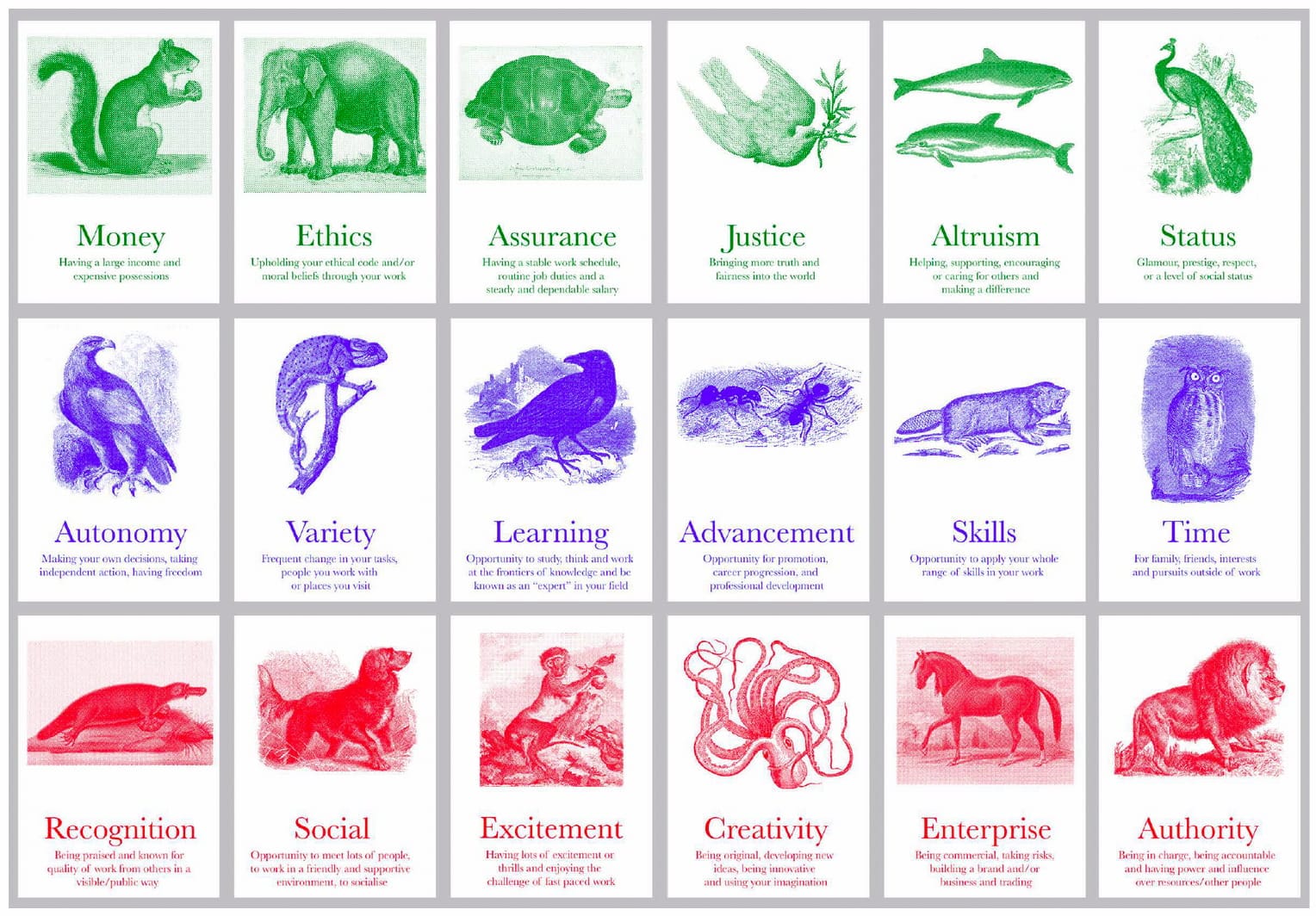
A grid of 18 cards showing creative values, organized in three rows with vintage animal illustrations in green (top row), purple (middle row), and red (bottom row). Each card pairs an animal image with a creative value concept: Top row (green): Money (squirrel) - 'Having a large income and expensive possessions', Ethics (elephant) - 'Upholding your ethical code and/or moral beliefs through your work', Assurance (turtle) - 'Having a stable work schedule, routine job duties and a steady and dependable salary', Justice (olive branch) - 'Bringing more truth and fairness into the world', Altruism (dolphins) - 'Helping, supporting, encouraging or caring for others and making a difference', Status (peacock) - 'Glamour, prestige, respect, or a level of social status' Middle row (purple): Autonomy (eagle) - 'Making your own decisions, taking independent action, having freedom', Variety (frog) - 'Frequent change in your tasks, people you work with or places you visit', Learning (raven) - 'Opportunity to study, think and work at the frontiers of knowledge and be known as an "expert" in your field', Advancement (horses running) - 'Opportunity for promotion, career progression, and professional development', Skills (lizard) - 'Opportunity to apply your wide range of skills in your work', Time (owl) - 'For family, friends, interests and pursuits outside of work' Bottom row (red): Recognition (seal) - 'Being praised and known for quality of work from others in a visible/public way', Social (dog) - 'Opportunity to meet lots of people, to work in a friendly and supportive environment, to socialise', Excitement (person with swan) - 'Having lots of excitement or thrills and enjoying the challenge of fast paced work', Creativity (octopus) - 'Being original, developing new ideas, being innovative and using your imagination', Enterprise (horse) - 'Being commercial, taking risks, building a brand and/or business and trading', Authority (lion) - 'Being in charge, being accountable and having power and influence over resources/other people'

Anyway, LOTS of stuff to sift through… I’ll see you all again in a few years! 😉

Speaking of card decks…

Wild Card Deck (NPR)

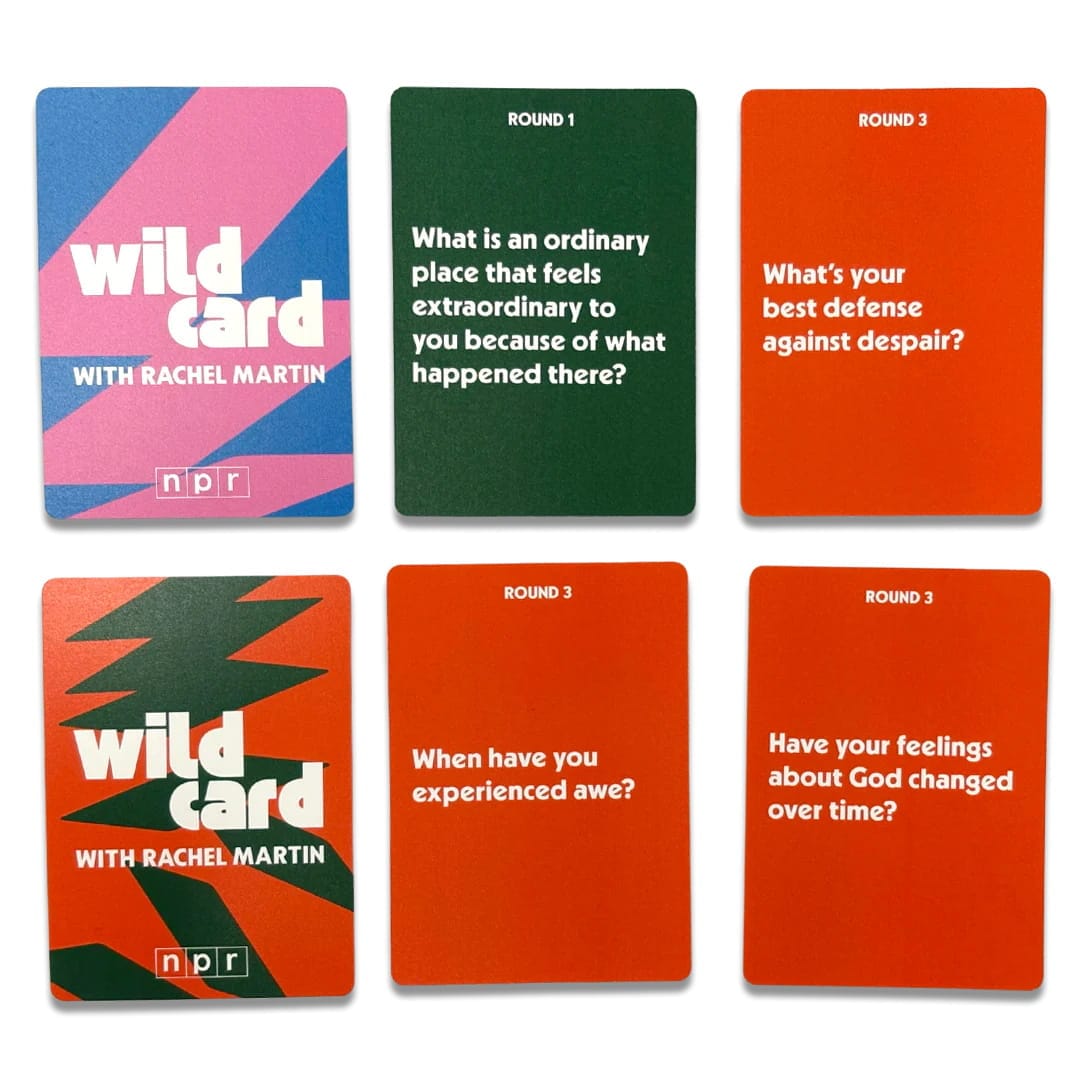
I was listening to Wild Card with Rachel Martin, the NPR show where celebrities and creatives answer deep life questions drawn from a deck of cards.And I thought to myself “dang, these questions are really good… I wonder if anyone has captured all these… Or if there’s a card deck yet…” A moment and a search later, and… Serendipitous timing! 🎉 It turns out NPR just released—this month—the Wild Card Deck. Instant buy for me.
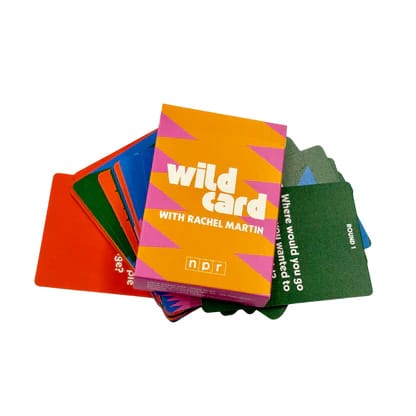
A fanned-out deck of colorful cards from the NPR podcast 'Wild Card with Rachel Martin.' The top card features an orange and pink geometric design with white text displaying the show title and NPR logo. Behind it, multiple cards in various colors including red, green, blue, and orange are visible, with one green card showing partial text reading 'Where would you go to' and 'round yourself.' The cards are conversation prompts or question cards from the podcast.

The Weight of Worry

An analogy to think with: The Weight of Worry: When to Let Go [LI]. You can put this next to the Spoon Theory:

A professor held a glass of water.
He asked his class one simple question.

"How heavy is this glass?"
Students answered:
8 ounces. 12 ounces. Maybe 16.

He smiled and said weight was irrelevant.
What matters is how long you hold it.

One minute feels like nothing at all.
One hour makes your arm start aching.
One full day paralyzes you completely.

He set the glass down on the table.
The lesson landed harder than any textbook.

Your stress works the exact same way.
A worry held briefly causes zero damage.
That same worry carried all day destroys you.

The problem was never the glass itself.
The problem was refusing to set it down.
High performers fall into this trap constantly.

They carry every project, every deadline, every fear.
They mistake relentless grip for mental toughness.
But paralysis disguises itself as perseverance sometimes.

The strongest leaders know when to let go.
They put the glass down before it breaks them.
Rest is a strategy, never a weakness.

QUESTIONS:
1/ What glass have you been holding far too long?
2/ When did you last give yourself permission to set it down?

🫳
🎤
Read more

№ 115 | Copyright: The Card Game, Design Thinking Canvas, The Learning Matrix, “Moving From SWOT to SO WHAT? Analysis”, Prosocial Design Network, Lenny’s World… Remixed!, and Violence as a Contagious Disease

№ 115 | Copyright: The Card Game, Design Thinking Canvas, The Learning Matrix, “Moving From SWOT to SO WHAT? Analysis”, Prosocial Design Network, Lenny’s World… Remixed!, and Violence as a Contagious Disease

I'm back again, with your regular roundup of ‘playful things to think with’ and think about! (Two days later than usual, but… other priorities!) Copyright: The Card Game Now this is how you design a learning card game! Take a confusing topic (in this case copyright law). Create

By Stephen P. Anderson
№ 114 | Platform Thinking Journey Cards, The Dictionary of Radical Alternatives, Learning Theory Map, “Let Them Have Your Way” Zine,  a Framework Mashup!, “There is No System 2”, Go for Goals, and Gutenberg Revisited

№ 114 | Platform Thinking Journey Cards, The Dictionary of Radical Alternatives, Learning Theory Map, “Let Them Have Your Way” Zine, a Framework Mashup!, “There is No System 2”, Go for Goals, and Gutenberg Revisited

Welcome to another curious roundup of ‘playful things to think with’ and think about! Platform Thinking Journey Cards Here’s a shout out to my friend Werner Puchert, who just dropped another one of his extensive card deck video reviews. This time, he’s looking at the Platform Thinking Journey

By Stephen P. Anderson
№ 112 | Teaching One Pagers, Sliderule Simulator, Board Game Icons, “Making, Hacking and Jamming”, FLARE, Relooted, Choosing a UX Research Method, and Deep Musings on our Human Relationship with AI

№ 112 | Teaching One Pagers, Sliderule Simulator, Board Game Icons, “Making, Hacking and Jamming”, FLARE, Relooted, Choosing a UX Research Method, and Deep Musings on our Human Relationship with AI

Welcome to another edition of the Thinking Things newsletter, your regular dose of playful things to think with, and think about. 🫵A couple of things: 1/ ♥️ ♠️ ♦️ ♣️ I’m exploring a special edition of thinking things focused on… 🥁 playing cards. Specifically, any activity that uses a standard deck of playing cards

By Stephen P. Anderson