№ 117 | A Special “Two-fer” Edition: Museum Activities, Attention, Technology & Childhood Education, Writing Together, Two Critiques of Org Change, and More Great Conversation Starters


A special “two-fer” edition, featuring things to think with or think about—that happen to pair nicely with each other!
Context: While collecting the various things that make it into this newsletter, I sometimes come across posts, frameworks, etc. that feel better to share together, as a pair (or triptych). There’s a nice thematic pairing. These things might complement each other or offer contradictory perspectives. While fine on their own, I feel there’s more to think about when paired together.
So, that’s what this special edition is all about.
That said, this edition of the newsletter comes with a bit of a disclaimer: The nature of these pairings tends toward ‘things to think about’ (as opposed to the more common ‘playful things to think with’). Translation: More words. Fewer pictures. Deep thoughts and musings ahead… 🤷♂️
Oh, and many of the links below are to LinkedIn [LI]. Apologies.
Museum activities
First up, a lightweight pairing: Two different museum activities that visitors can think with.
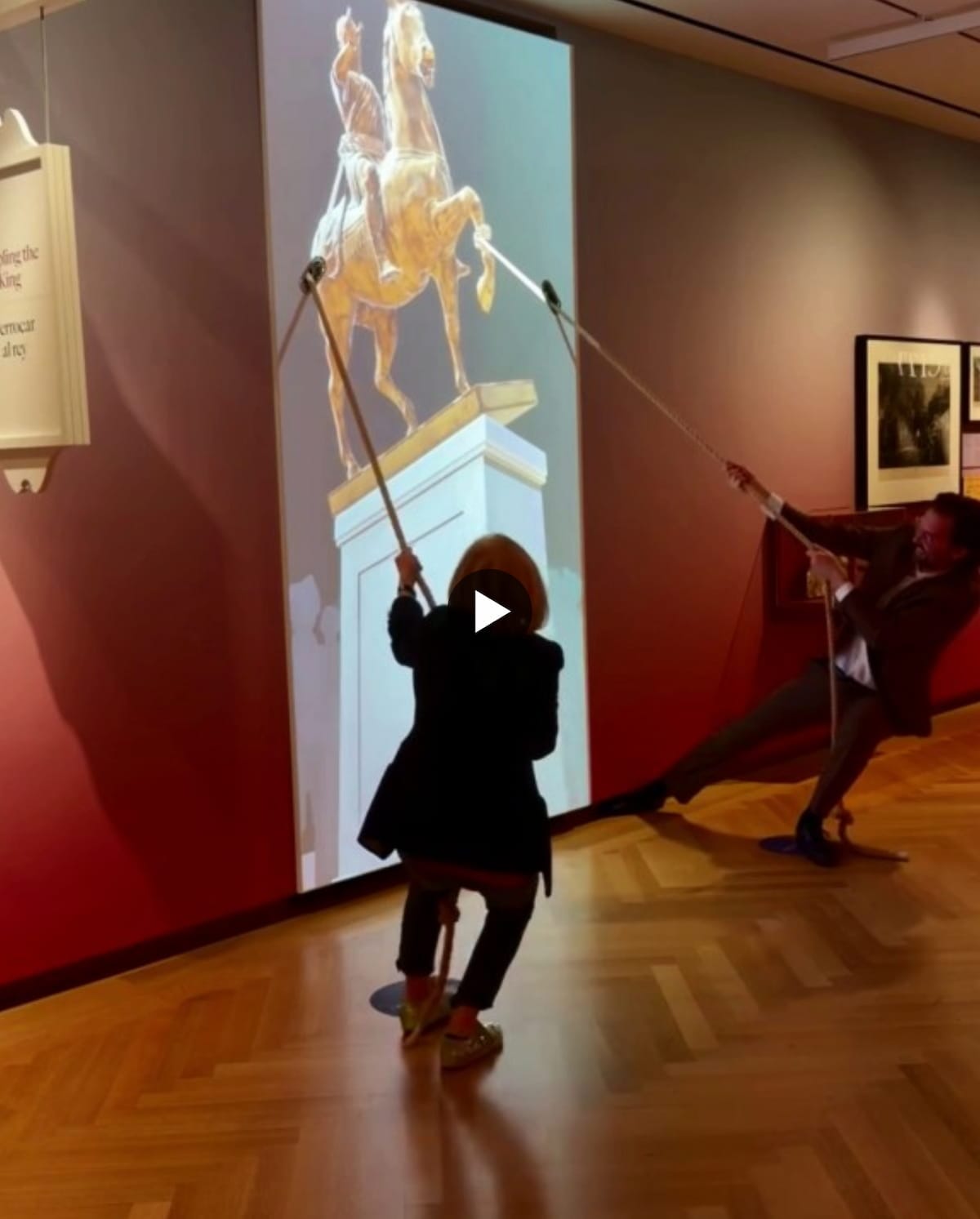
The first, an interactive museum exhibit transports you back to a moment in 1776, as you and a partner physically pull ropes to bring down a (digital) statue of King George III [LI].
The second is a simple but fabulous way to teach the CMYK printing process [LI]—using stamps to turn this method of printing into “a tactile art experience”.
I created a set of 20 custom stamps, each with a different dot matrix pattern, ink density and angle, mirroring how colour plates are arranged in print. With these stamps, it’s possible to generate up to 1,295 CMYK colour combinations!
By stamping layers of cyan, magenta, yellow and black dots, participants could create their own analogue ‘pixel art’ prints.
After printing, participants could examine color magazines, newspapers and more under a microscope…
The slow, tactile process of stamping seemed to unlock a different kind of engagement: participants spent time crafting their artworks, often coming back for more paper to try new ideas.

🩵 🩷 💛 🖤
Attention
Next up, two pieces on the topic of ‘attention’.
Whatever your thoughts on Jonathan Haidt, I think we can all agree with the one thing he asks us to remember from his graduation speech at NYU 2026 [LI]:
« Treasure your attention »
Bonus points for the shout out to poet Mary Oliver and her poem Instructions for living a life:
Pay attention.
Be astonished.
Tell about it.
That’s it. That’s the poem.
Pretty cool, huh?
😍
And for a slightly more nuanced take on attention, we have the Playing With Attention zine [LI] from Alastair Somerville. Based on ideas from the book Attensity!, these brief pages can help us to reflect, plan, and be more intentional with our attention.
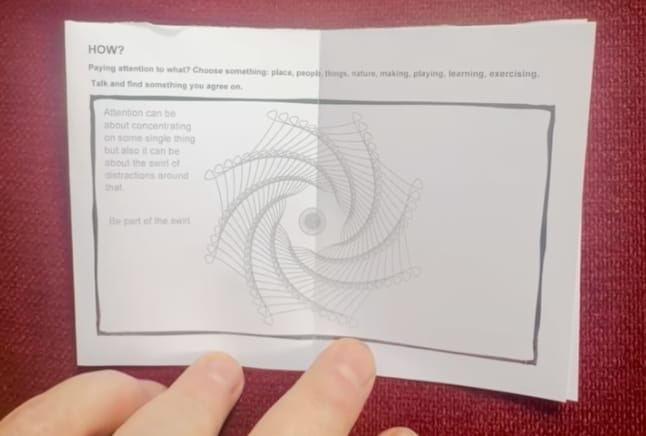
Which… also brings to mind these timeless words of wisdom from Brian Eno: Pay attention to your attention.
Full quote, below, courtesy of Andrea Mignolo:
“…everything requires attention, that's the main thing to remember. Every new thing you add requires attention and I think the most important resource in the world right now is your attention. That's why huge industries exist to capture it. Facebook, Google, everything exists to capture your attention and to monetize it in some way. So, my message to everyone now is don't get a job if you can avoid it and look after your attention. Really pay attention to your attention. Where is it? What's it doing? How often in the day do you actually have time when your attention is not being taken up by somebody else or by something else?"
Wait, was that a three-fer? Well, if we’re going to break away from the two-fer pattern…
3 reads on technology and childhood education:
First off, here’s a delightful paper from Alan Kay… written in 1972: A Personal Computer for Children of All Ages [PDF]. The first half is focused more on pedagogy and “speculates about the emergence of personal, portable information manipulators and their effects.” In it, Kay describes how children learn by doing, with shout outs to the likes of Papert, Piaget, Bruner, Montessori, and Suzuki (see a theme here?). The illustrative example shows two kids playing and discovering, teaching themselves in the process, as they use their “DynaBooks” to acquire and manipulate information.
It is now within the reach of current technology to give [everyone] a "DynaBook" to use anytime, anywhere as they may wish. Although it can be used to communicate with others through the "knowledge utilities" of the future such as a school "library" (or business Information system), we think that a large fraction of its use will involve reflexive communication of the owner with himself through this personal medium, much as paper and notebooks are currently used.
From here, Kay expands on the notion of the computer as a tool, and potentially much more:
A tool is something that aids manipulation of a medium and man is cliched as the "tool building animal". The computer is also regarded as a tool by many. Clearly, though, the book is much more than a tool, and man is much more than a tool builder...he is an inventor of universes. From the moment he learns to see and to use language, each new universe serves as a medium (and constraint) of expression in which imagined structures can be embedded, usually with the aid of tools. What about computers? They are clearly more than a tool also, though in typical Mcluhanesque fashion, much of their content has been adopted from previous media, and their own attributes are just beginning to be discovered.
What then is a personal computer? One would hope that it would be both a medium for containing and expressing arbitrary symbolic notions, and also a collection of useful tools for manipulating these structures, with ways to add new tools to the repertoire.
Remember: This is a decade before PCs would become commonplace. And nearly two decades before the World Wide Web became a thing (though Arpanet was around in 1969).

Contrast the optimism of Kay’s paper with this more sobering take on computers from 1985…
Here we have an interview with Professor Joseph Weizenbaum, creator of ELIZA, the first famous chatbot. When asked about the role of computers in education, he pushes back on the question, with this reframing:
People come to MIT and to other places… and in effect they say, "You have there a very wonderful instrument which solves a lot of problems. Surely there must be problems in my establishment -- in this case, the educational establishment, for which your wonderful instrument is a solution. Please tell me for what problems your wonderful instrument is a solution.
The questioning should start the other way -- it should perhaps start with the question of what education is supposed to accomplish in the first place.Then perhaps [one should] state some priorities -- it should accomplish this, it should do that, it should do the other thing. Then one might ask, in terms of what it's supposed to do, what are the priorities? What are the most urgent problems? And once one has identified the urgent problems, then one can perhaps say, "Here is a problem for which the computer seems to be well-suited." I think that's the way it has to begin.
Preach! I think a term for what he pushes against is “solutioneering”—placing a vendor, or pre-existing solution (in this case the computer) into the problem framing statement.
I highly recommend the rest of the essay, especially his description of the computer as a “a fundamentally conservative force.” [Hint: Power structures. Decentralization vs Centralization. Social invention vs technical invention. It’s a 🤯 perspective!]
(h/t Erika Hall [LI])
Let’s build on this pairing—Alan Kay’s paper and the interview with Weizenbaum—by adding in this concise and thought-provoking post “Beyond the Engagement Trap: A New Design Architecture for Children & AI” [LI].
This post is mostly written as a way to name and decry Big Tech’s default approach to media of all forms—including children’s media—which is to maximize engagement at all costs. This sentence sums up things rather well:
Without a developmental lens, these become tools for retention rather than for children’s growth.
So what are the proposed shifts? Briefly, they are:
- From Interactive to Relational
- From Personalized to Pluralistic
- From Adaptive to Developmental
- From Intimate to Equity-Oriented
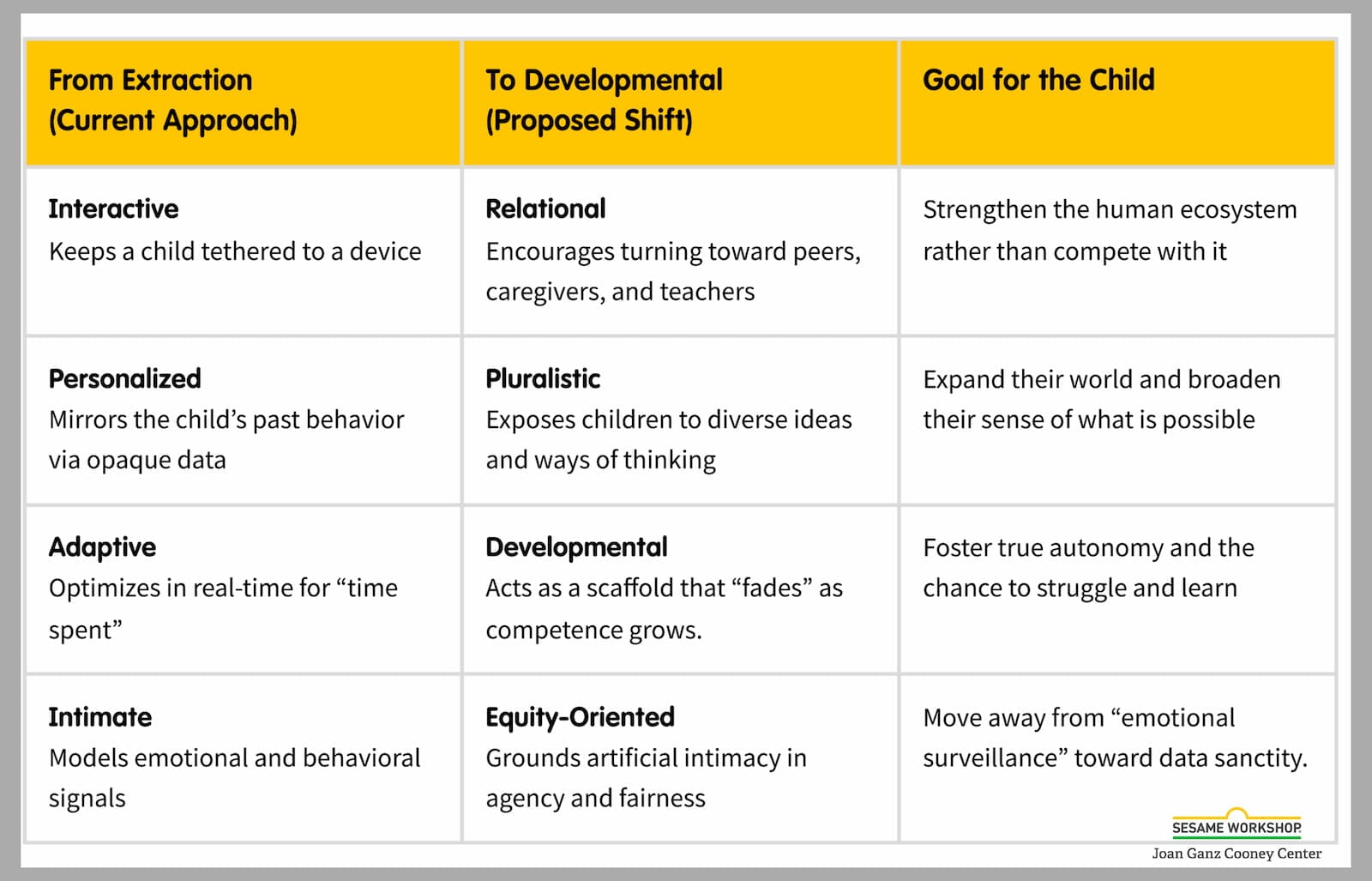
That first shift— From Interactive to Relational—really grabbed me. While interactive in this sense is more about hooking children (“continuous feedback loops designed to keep children engaged”) the proposed shift to relational is what gave me pause. How might we design tech that “encourages turning toward peers, caregivers, and teachers?”
Much of personal computing—for learning purposes—has been a solitary learning activity, as opposed to a relational one. In 2014, I wrote a chapter for the book Designing for Emerging Technologies, in which I described a digital tool that teaches basic math concepts through direct manipulation of physical objects placed on a touchscreen. One of the virtues I praised was the ability of the tool to replace a person, by offering immediate feedback loops. I was thinking about independent, self-directed learning (which there is nothing wrong with). However, this post leaves me thinking more about collective learning. And ways that digital tools for learning might support this relational challenge…
🤔
Which leads us to the next two-fer, beginning with a classroom experiment I’ve been thinking a lot about…
(h/t Dan Brown)
Writing together (the collective essay and multiplayer AI)
As a former high school teacher, I’ve wrestled with how I would, were I still teaching (in the formal sense), respond to “student” papers written by ChatGPT. This description of a new kind of essay, an experiment from assistant professor Tom Kaspers, is one of the smarter ideas I’ve come across. Essentially, he invited his students to write a single, collective essay.
In an attempt to reimagine the essay assignment, I asked my students if they would want to write an essay together, with me.
My thought was that I would take the place of AI. We’d be in a continuous conversation, bouncing ideas off one another, seeing our theory grow sentence by sentence. Students would have to properly engage in every class to understand where the essay was going. And they’d constantly have to defend their own writing, not just to me but to their fellow students. They might still use AI, but I hoped it would be sufficiently inconvenient to do so. At the very least, they’d have to participate in class, communicate and defend their contributions, and collaborate with me and their fellow students to revise their writing.
🤯
What I love about this reframing is it’s not only a response to the use of AI, but it’s scratching at a more fundamental question: What is the value of the independently written essay—as a formative learning activity? That, by itself, is a dramatic challenge to something we’ve not scratched at in… (checks notes) the history of education?
Oh, and later in his article, Kaspers has this to say:
I saw the classroom transformed into a self-organizing collaborative space… Stop having your students write for you, and have them write with you.
🤩
This “collective essay” idea forms a nice pairing with the next topic: Multiplayer AI.
First, some rambling thoughts:
One of the things I’ve experienced is how the current wave of AI tools are rather… anti-social. As currently implemented, the “AI as chatbot” (or command line prompt) form of interaction is a solitary activity. It isolates us. And discourages collaboration. Imagine we’re part of a team, working together. We all go off and have our own conversation with the latest model. When we gather again, the resulting disagreements are even harder to resolve than they were before AI, for a host of reasons: The volume of information. Lack of visibility into prompts used by others. False confidence in “our” found information. Debates about which models were used… And so on. These AI ‘genies’ can be downright divisive. In the same way that we eventually shifted to tools that support real-time collaboration (e.g. Google Docs), I predict—or hope— we shift to more collaborative AI tools. Which is why I was excited to see John Cutler orbiting similar ideas:
People with a bias toward working alone suddenly have a whole new quiver of tactics to avoid working with other people. They set up agents. They send copious documentation. Their agents talk to your agents. They shut down conversations with hastily pulled together, but very persuasive, deflectors…
People who see value in collaboration are now overloaded trying to handle the overflow of decision-making, noise, and responses to all of these async tactics. They are desperate to be thoughtful while dealing with this deluge of theoretically replaceable moments.
This is from a LinkedIn post [LI] as recent as a few days ago, but it’s this post, from a few weeks ago that grabbed my attention. In it, John describes three patterns for how teams use AI [LI], with this tidy little table:
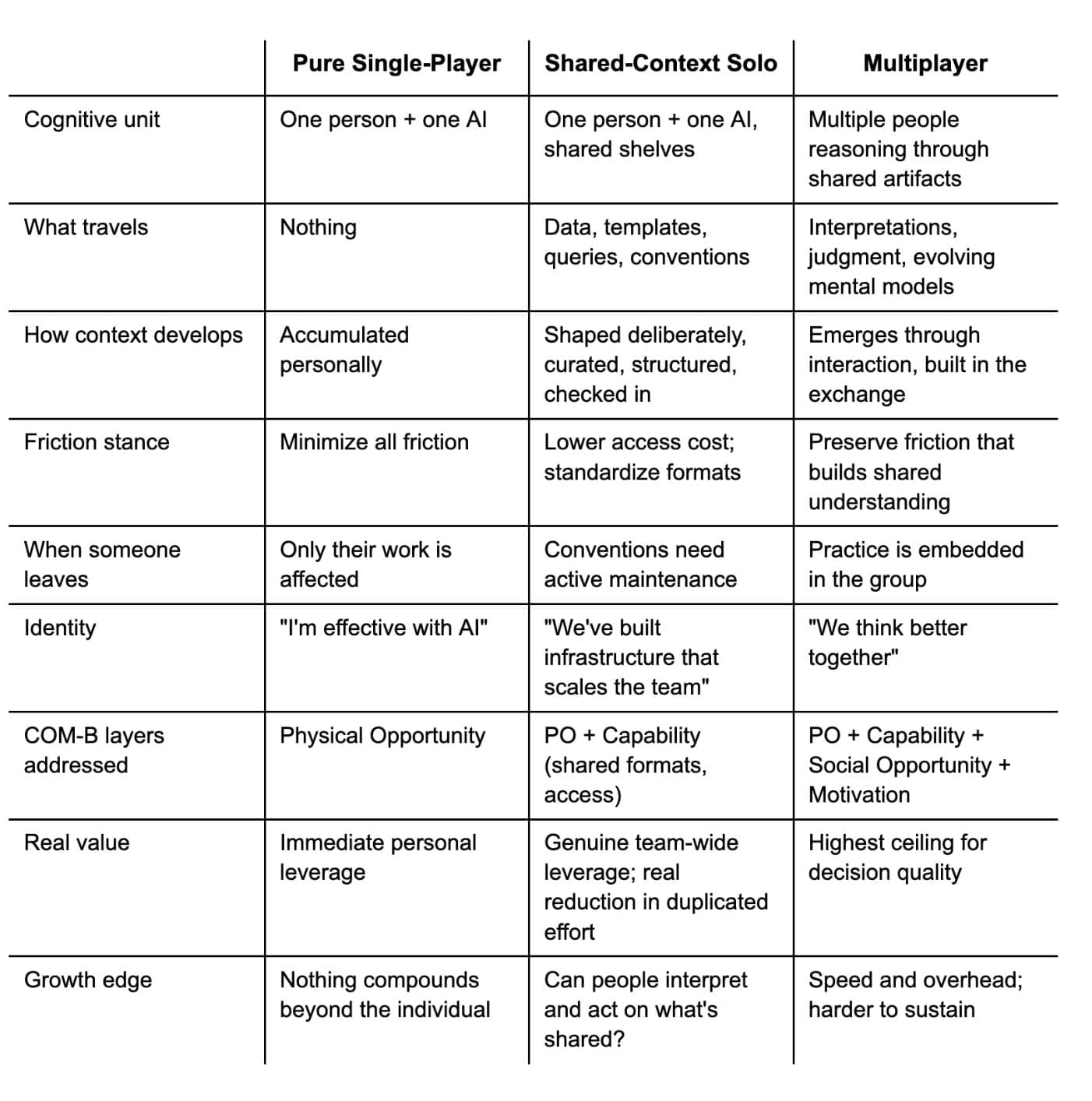
His point? While teams are moving to the middle column, having a shared, “centralized context is not multiplayer mode.” So, thinking about multiplayer games (and collaborative software), what does multiplayer AI look like? That’s something I’ve been thinking about…
Here’s a nice little bonus article to tie things together: Buried in the comments on the LinkedIn post that first mentioned the collective essay experiment, was this gem of an essay: “The Adolescence of Humanity - harnessing powerful AI for collective intelligence.”
Two critiques of org change
The next two finds are specifically related to organizational change and transformation. And… they’re critical in the best ways possible.
The first critique comes from Mark Eddleston, who—after years of promoting and leading organizational change efforts—confesses his disillusionment with this work.
That’s what this book is about. Not another system for making work better. A reckoning with why the systems don’t work, and what that tells us about work, about organisations, about what we can and can’t change.
He has a draft manuscript—Why Change Fails—from which he’s been publicly sharing chapters, to get feedback. I’ve found the writing and examples to be delightful. And, as loyal readers of Thinking Things will know, I love a good challenge to conventional thinking.
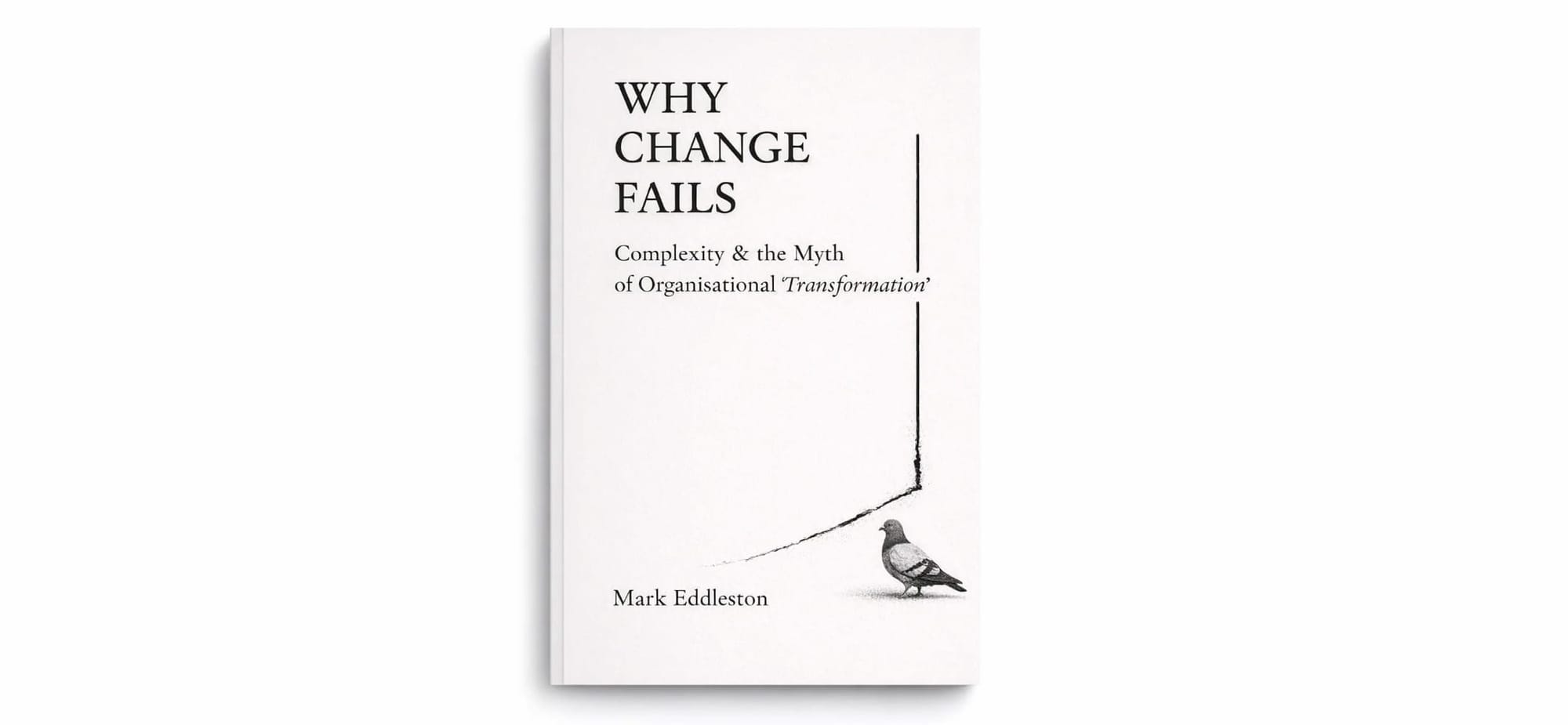
You can start in the middle, like I did with Chapter 4 | Linear Thinking’s Origin Story [LI], or start from the beginning with: Chapter 1 | The book I didn't expect to write….
The next find looks at the history of a framework commonly used in org changes —the Kübler-Ross (stages of grief) [LI]— and asks us to reevaluate whether this is an appropriate use of the tool. And, does use of this framework for org changes suggest something more deeply concerning.
Elisabeth Kübler-Ross was a Swiss-American psychiatrist working in the 1960s with terminally ill patients. She developed her five stages by sitting with people who were dying, or watching someone they loved die. The framework describes the emotional journey of confronting an irreversible, non-negotiable loss. Death does not ask for your input. It does not run a consultation process. It does not care about your concerns or your ideas for how things could be done differently. The only dignified response available to you is, eventually, to accept it.
And yet here we are, applying it to office reorganisations. Think about what this tells you. If your change methodology is built on the assumption that people will move through grief stages, you have already decided something important: that this is happening to them. That they have no meaningful say. That their job is not to shape the change but to survive it.
If you’ve been a part of an org change, there’s a good chance someone invoked the “stages of grief” as a tool for people to assess where they were at with the—often dramatic—changes. I love that this post points out why this might be a bad idea.
More great conversation starters
A few weeks ago, I shared the Wild Card Deck, which pulls questions from Wild Card with Rachel Martin, the NPR show where celebrities and creatives answer deep life questions drawn from a deck of cards. If you missed that, here’s your chance to take another look!

I want to add to this deck with two additional sources of really great reflection or conversation starter questions.
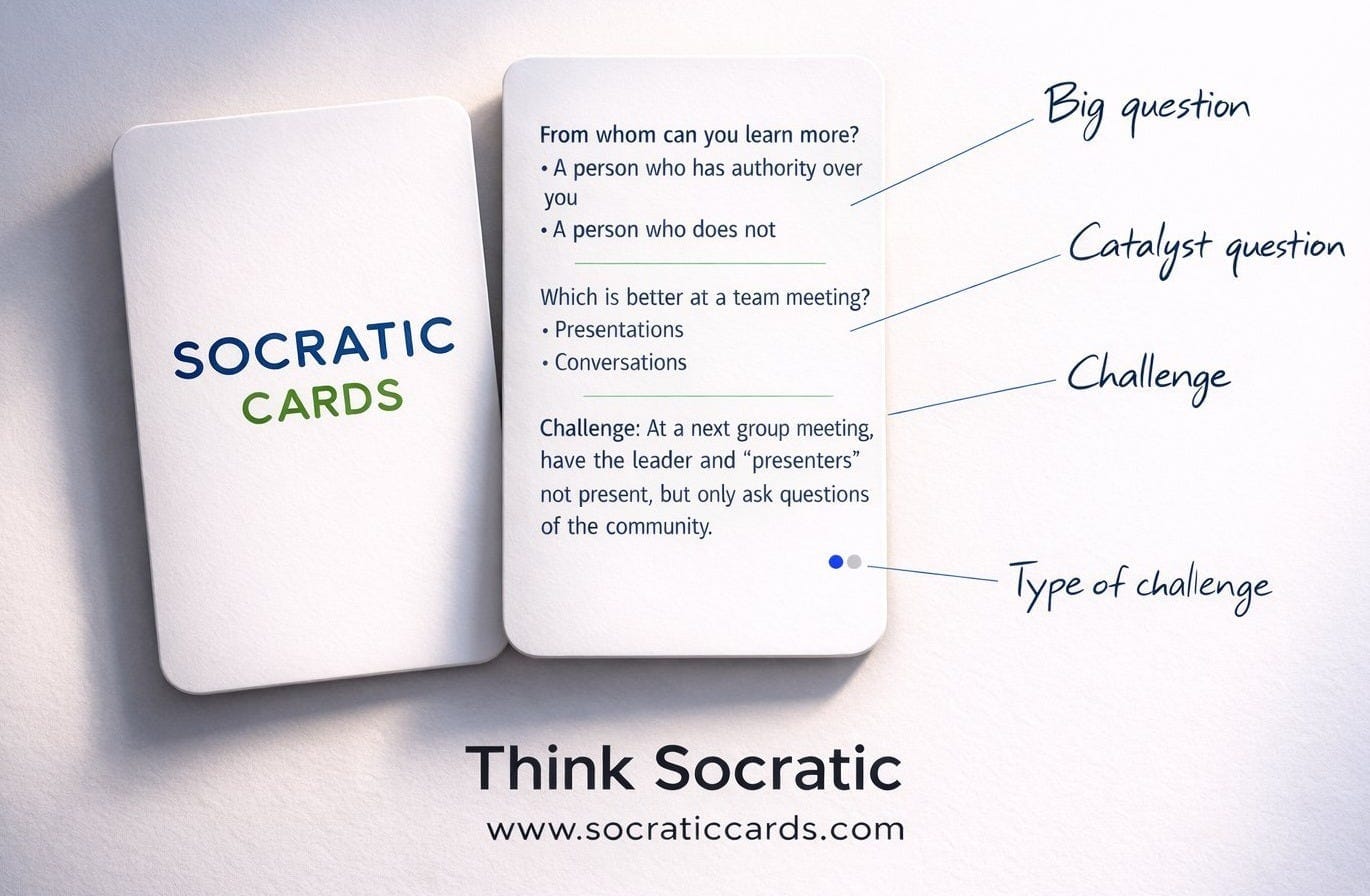
The first is also a card deck, the Socratic Cards. I encountered these via the Cardstock group and assorted comments about this rather curious post: “How the Brilliant Design of Alcoholics Anonymous Inspired Socratic Cards.” It’s the content of these cards—specifically the pro version—that intrigued me. Designed for small teams, you:
- Kick things off with Big question often phrased as an “A or B?” option,
- Go deeper with a Catalyst question, and
- Follow up with an optional Challenge.
You can see an example in the image below:
The cards align to the following topics:
- Using time well
- Achieving excellence
- Finding your calling
- Mental models
- Reducing drama
- Building habits
- Increasing energy
… and are rated one of three difficulty levels.
Which leaves us with…🥁 ✨Magical Questions✨
I’m a bit obsessed with the notion of ✨Magical Questions✨ being promoted by Priya Parker (author of the book The Art of Gathering).
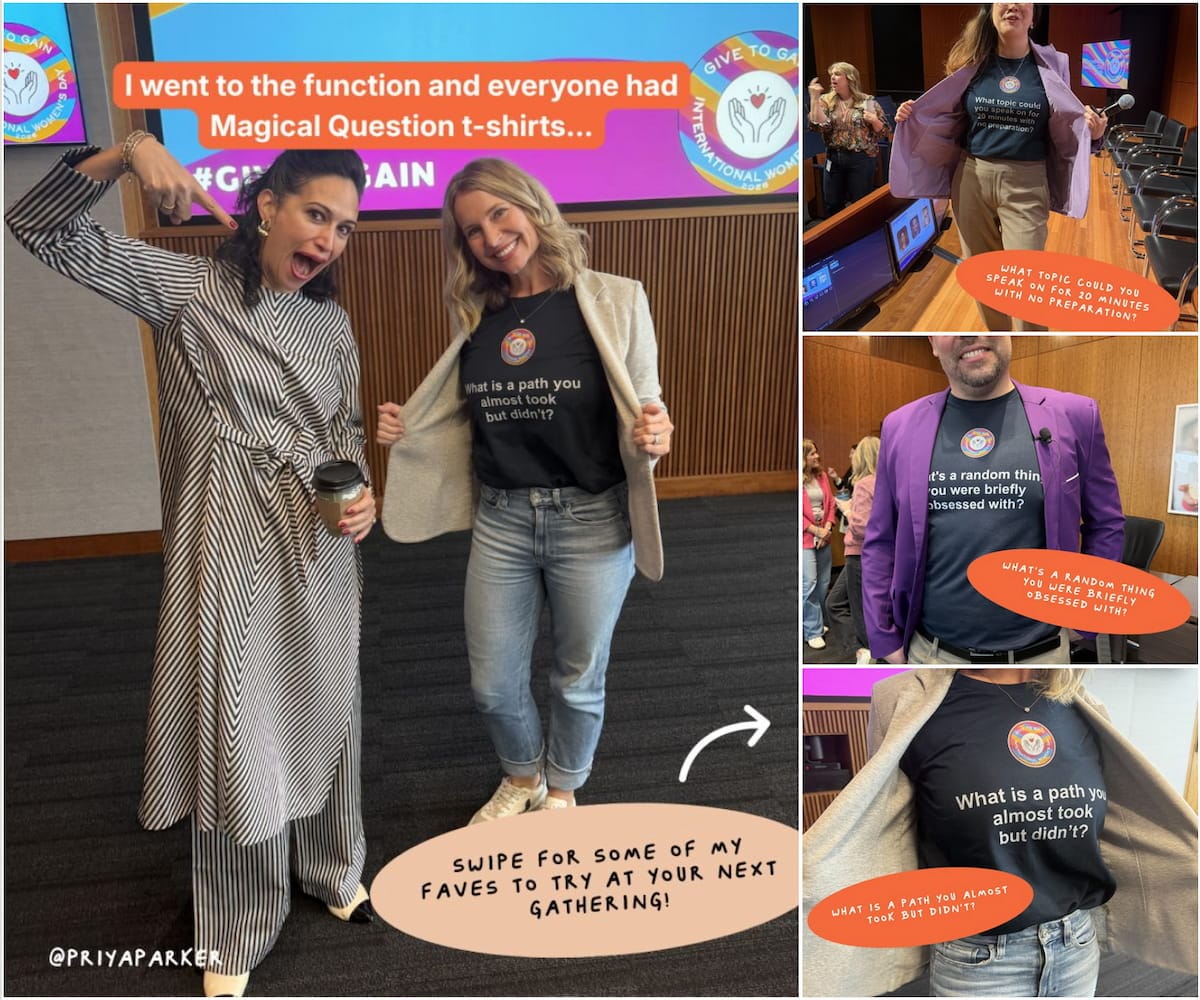
Essentially, a Magical Question is “one that everyone in YOUR group is interested in answering and everyone is interested in hearing everyone else’s answer.” As an extension of her focus on creating memorable gatherings, this branch makes sense. While Parker’s focus is more the art of crafting these questions—with a special emphasis on crafting unique questions for YOUR gathering—many of the questions that have been shared are great openers for many types of gatherings.
For example:
- What topic could you speak on for 20 minutes with no preparation?
- What’s a random thing you were briefly obsessed with?
- What’s ONE reason I should live where you live?
- What is your best recent random purchase—just for fun?
- If you could do any job that you’re not qualified for at all, what would it be?
- What are you currently reading that you want to share with everyone?
- What are three gifts you would give aliens on behalf of humanity?
- What is a favorite building in your community? When did it become so?
I find the questions energizing, open-ended, and they let you learn (or share) something—without getting too personal. A good Magical Question manages to be fun, revealing, and safe.
While there’s no card deck yet (ahem) that I am aware of, you can get a good sampling of the questions from Priya Parker’s Instagram reels; this LinkedIn post is also a good place to start. And, she also routinely shares new questions in the form of a mini guide exclusively for her Group Life members.
Here’s more information about Magical Questions in this episode of Life Kit: “Want to cut through small talk? Try asking a 'magical question’.”
And that’s all folks!
I had a batch of random fun stuff to share, but I’ll push that off until the next issue—this issue is already a bit long for my liking. 😜
Until next time… Cheers!