№ 12 | Collaboration (x2!), Tensions with Innovation Processes, 3 Types of (Personal) Challenges, and a “Post-Growth” Charter
Here's a two-fer on the topic of collaboration. I love both of these articles in that they are scratching at the catch all idea topic of collaboration…
Against collaboration?!
“How to build silos and decrease collaboration (on purpose)” certainly caught my attention! I'm not sure about this one, though I welcome challenging, contrarian ideas. While it is certainly (exponentially?) more complex to scale collaboration across teams, it is not, I believe, a challenge we should shy away from. I do ♥️ that the author includes a distinction between communication, collaboration, and coordination (FWIW I also add ‘cooperation‘ to this list, and see these arranged on a continuum of sorts). A lot rests on this distinction between coordination and collaboration across teams, the former being something the author does advocate for. The other thing that complicates this thinking is the nature of the problem being solved. Team autonomy, as described in this article, works better with simple or complicated projects, but when something is complex and teams are learning and changing in response to these learnings, then you need more collaboration, not less. Also noticeably absent is the definition of a team: Are we talking about ‘two-pizza‘ teams, or a department with dozens or hundreds of people? Are these cross-functional or job family teams? A lot hinges on the answers to these questions. Sorry to rant! What are YOUR thoughts?
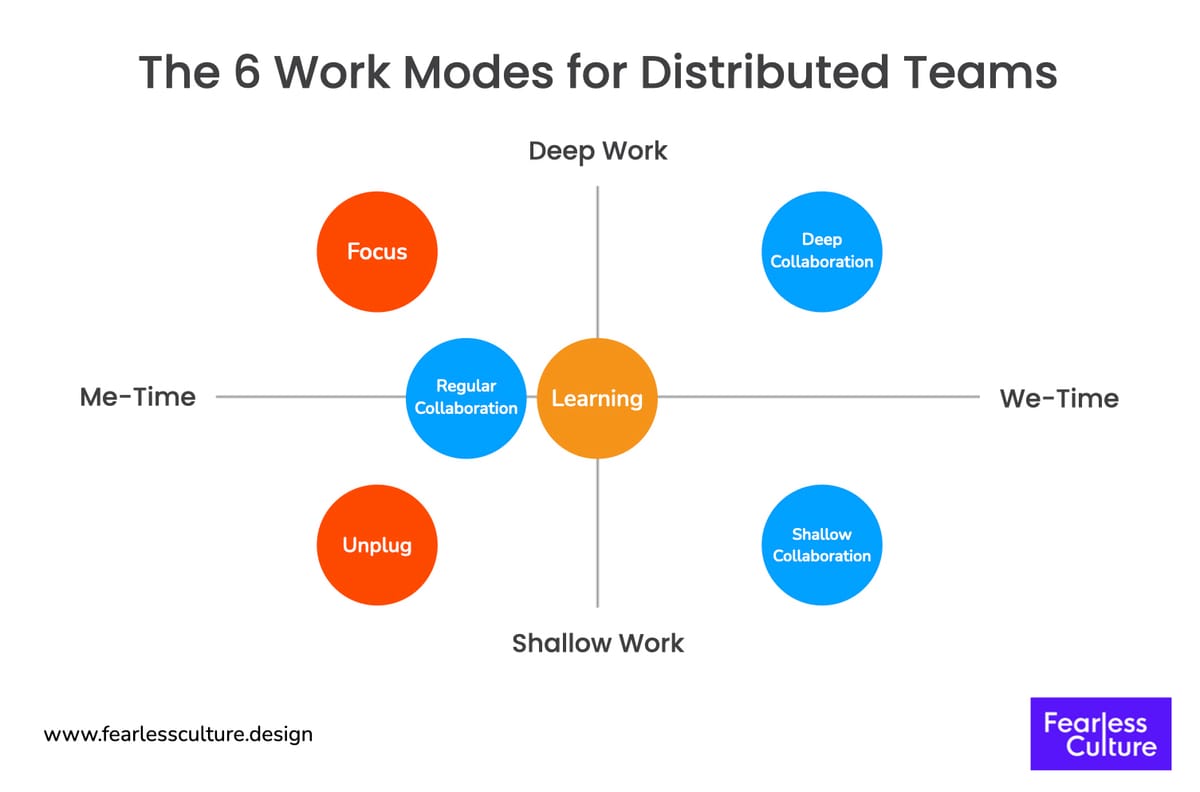
“Six modes of work for remote collaboration”
For a more diagnostic approach to collaboration, check out this post on the “Six modes of work for remote collaboration.” “The key to successful collaboration is knowing when it’s not necessary to collaborate.” Cool, cool. The trick is to be intentional about collaboration. To this end, the author offers up a handy framework for thinking about types of collaboration. I love this approach, though I'll want to sit with and test it out this exact model (where, for example, does looping in exactly one other person for deep work fit?).

Tensions associated with healthcare innovation
Another bit of synthesis waiting to be turned into a game? 🤔
While the information overload is full on in this visual, it looks to be solid. This map offers “a better understanding of these multi-layered and sometimes resistant structures, relations and processes that determine the path of an innovation from invention and development to deployment and dissemination in the healthcare system.” Whew. Zoom in and you see plenty of research citations. I'm in. I wonder if this could be generalized to other industries?

A “post-growth” charter
Phrases like “post-growth,” “post-capitalism,” and “the limits of growth capitalism” sometimes work their way into my conversations. Here's a really great manifesto/exploration of a post-growth principles: Our Charter - Post Growth Institute.
Three types of challenges?
In this short post ”Headaches, Opportunities, Dreams,” coach Ed Batista proposes “many—and perhaps most—of our challenges fall into one of these categories: Am I curing a headache? Am I pursuing an opportunity? Am I dreaming a dream?”
***BONUS!
Womp promises "a new way to 3d"—and it doesn't disappoint. Set aside some time this week to play, and have fun making 3D objects. Yes, 🎉FUN🤪 playing with a 3D program, you heard me right! Pro amateur tip: Don't try to build something specific—embrace the sEr3NDipi+y!!