№ 4 | Contrasts and Meaningful Distinctions, Engagement, Explaining Ontology and Epistemology, Patterns in Choice-Based Games, and Text to Image Generation

Share
№ 4 | Contrasts and Meaningful Distinctions, Engagement, Explaining Ontology and Epistemology, Patterns in Choice-Based Games, and  Text to Image Generation

Contrasts and meaningful distinctions

🤩 A co-worker shared this brilliant list of critical distinctions, gathered by Frank Chimero over the past few years. [No direct source, as I believe this was from a private newsletter?]

Here's the snippet: 

The pandemic has given me a cynical distance to professional language—work words slough meaning in the dissonance of a world pretending it is business as usual in truly exceptional times of suffering. As an exercise, I started a list of meaningful distinctions, wondering how I could find a kernel of interest, truth, and personal resonance in the catch-all, vague, lazy words I despised. I am sharing my list after 18 months, because it has become a pocket-sized ethos, a dialectical approach where the separation of ideas makes each more coherent. It is a reminder that no matter how crudely we may label things, the actuality of a red-orange face, the peach of the sky, the whichever wine blue of the sea are all still there, waiting to be summoned again with the right word.

Meaningful distinctions:

* Profit vs benefit
* Simplicity vs clarity
* Success vs progress
* Convenience vs comfort
* Fun vs satisfaction
* Thoughts vs thinking
* Information vs knowledge
* Choices vs decisions
* Scale vs resonance
* Achievement vs influence
* Descriptions vs evaluations
* Expansion vs growth
* Consumption vs consideration
* Control vs initiative
* Happiness vs fulfilment

This also reminds me… I’ve been sitting forever on a post about using “contrasts” (similar to these) to create clarity. It’s chock full of examples whereby merely presenting two words/concepts/ideas next to each other makes it easier to understand and discuss critical, nuanced differences (and also why some people might avoid contrasts, for this very reasons—as it removes the “cover” of ambiguity).

Scratching at the word… “engagement”

Companies everywhere talk about measuring engagement. I love how this article probes deeper into what this might actually mean:  “The dangers of ‘Engagement’ as an untethered KPI” by Melinda Jacobs.

“How would you explain…

…Ontology and Epistemology to a child?” 😳  Fun to see how various folks responded to this challenge.

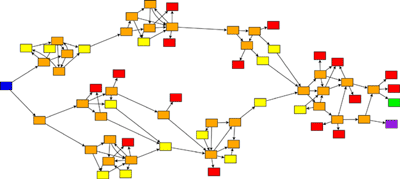
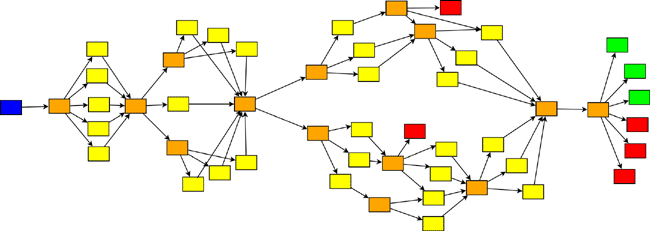
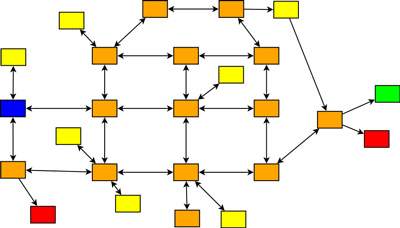
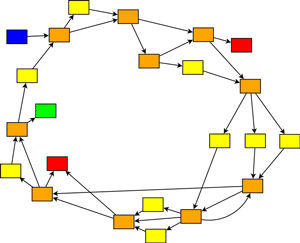
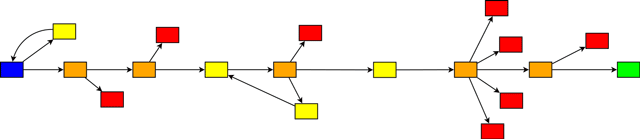
“Standard *patterns* in choice-based games”

I'm not sure if you geek out on this stuff like I do, but… wow! This article by Sam Kabo Ashwell has been described as “an essential article about structure in branching narratives.” If you want to gown deeper down the rabbit hole, and learn more about the writing process for interactive fiction, here's the Reddit thread where I came across this post.
And finally…

Text to image generation

Stable Diffusion, the newest AI image generator, has been making the news this week. Here's a Figma plugin that uses “prompts + simple shapes to design ideas.” 😮
Read more

№ 125 | Harms of the AI Ecosystem, OK Go Sandbox, Learning Experience Canvas, Family Tree of French Sauces, How Nouns and Verbs Shape Game Design, Harm Along a Spectrum, and Pain Point Bingo

№ 125 | Harms of the AI Ecosystem, OK Go Sandbox, Learning Experience Canvas, Family Tree of French Sauces, How Nouns and Verbs Shape Game Design, Harm Along a Spectrum, and Pain Point Bingo

Harms of the AI ecosystem At this point, just about anything Per Axbom creates is an instant share from me. His latest creation, an infographic identifying various “Harms of the AI ecosystem” is a fabulous ‘thing to think with’. Brief. Good use of dual coding. Seemingly comprehensive. I was initially

By Stephen P. Anderson
№ 124 | Deep Deck, Charismatic Language, “Are Student Attention Spans Really Shrinking?”, AI Divergence Engine, 10 Things to Watch Out for When Working with AI, “Society Begins at Home”, and Collective Madness Bingo Sheet

№ 124 | Deep Deck, Charismatic Language, “Are Student Attention Spans Really Shrinking?”, AI Divergence Engine, 10 Things to Watch Out for When Working with AI, “Society Begins at Home”, and Collective Madness Bingo Sheet

Deep Deck Let’s kick things off with a good ol’ analog card deck! Deep Deck is a deck of conversation starters that promises to “push strangers closer and pull friends deeper.” Deeper connections and all that. Long-time readers will know how bored I am by most of the

By Stephen P. Anderson
№ 123 | Deep Code Cards, Cultural Differences and Storytelling, “So You Want to Be an American?” (the Game), Work-Life Balance, the Smiley Model, Playful Visualizations—Using Trees!, and Deep Reading

№ 123 | Deep Code Cards, Cultural Differences and Storytelling, “So You Want to Be an American?” (the Game), Work-Life Balance, the Smiley Model, Playful Visualizations—Using Trees!, and Deep Reading

Howdy! Welcome to another roundup of ‘playful things to think with’ and things to think about. Let’s kick it off with… Deep Code Cards Ooh… Another project from Dark Matter Labs. The Deep Code Cards offer a “playful exploration of the invisible forces that shape our lives.” Nice. Maybe

By Stephen P. Anderson
№ 122 | A “Horseshoe” Diagram, Slow AI, the Data Communication Triangle, The Invisibles, A Simple Clustering Algorithm for Lists, Ordinary Abundance, and “Certainty, Variety, and Delight”

№ 122 | A “Horseshoe” Diagram, Slow AI, the Data Communication Triangle, The Invisibles, A Simple Clustering Algorithm for Lists, Ordinary Abundance, and “Certainty, Variety, and Delight”

A ‘horseshoe’ diagram Ooh… A horseshoe diagram?! That’s a new-to-me pattern; I’m adding this to my collection of visual primitives. Pretty much a cycle, with emphasis on the starting and ending points (before the cycle begins again). That’s all. Oh, and as for the content

By Stephen P. Anderson